
P
LANT
S
CIENCE
Bulletin
Summer 2012 Volume 58 Number 2
In This Issue..............
BSA Board Student Representatives
visit Capitol Hill...pp. 44
It’s the season for awards....pp. 38
BSA election results...pp. 51
BSA Legacy Society Celebrates !...pg ??
BSA’s Highest Honor Goes to...
2012 Merit Award Winners......page 38

From the Editor
Summer 2012 Volume 58 Number2
PLANT SCIENCE
BULLETIN
Editorial Committee
Volume 58
Root Gorelick
(2012)
Department of Biology &
School of Mathematics &
Statistics
Carleton University
Ottawa, Ontario
Canada, K1H 5N1
Root_Gorelick@carleton.ca
Elizabeth Schussler
(2013)
Department of Ecology &
Evolutionary Biology
University of Tennessee
Knoxville, TN 37996-1610
eschussl@utk.edu
Christopher Martine
(2014)
Department of Biology
Bucknell University
Lewisburg, PA 17837
c
hris.martine@bucknell.edu
Carolyn M. Wetzel
(2015)
Department of Biological Sci-
ences & Biochemistry Program
Smith College
Northampton, MA 01063
Tel. 413/585-3687
-Marsh
Lindsey K. Tuominen
(2016)
Warnell School of Forestry &
Natural Resources
The University of Georgia
Athens, GA 30605
lktuomin@uga.edu
The day after the last issue of PSB arrived in hard
copy, I had a telephone call from an old friend, Hugh
Iltis. Hugh has been weakened by strokes and his voice
lacks the volume he used to project, but his passion is
undiminished. He wanted to inform me of the typo in
Peter Raven’s printed address (see Erratum, p. 38) but
also to take issue with what he felt was a major omission
related to human population growth—its underlying
cause. Hugh’s issue was that Peter did not mention
the need for any kind of birth control, which is a main
factor responsible for population growth. Of course,
population growth was not the focus of Peter’s article so
it is not surprising that he did not elaborate on it. On
the other hand, Hugh had a point that we frequently
overlook. We, as botanists, tend to focus on the
immediate problem of feeding people while protecting
the environment, but this is a Band-aid solution to the
underlying problem of human population growth itself.
The discussion with Hugh reminded me that we have an
educational opportunity, and with our science majors
I feel we have an educational obligation, to emphasize
the limits as well as the power of science in solving the
problems we face as a society. Peter focused on what
we can do as botanists to alleviate the ever-increasing
need for feeding more people, but in a sustainable
way. Hugh would argue that by limiting ourselves to
these solutions we are only making the problem worse.
Together they illustrate that science, by itself, will not be
able to solve the problem. There are ethical, religious,
political, and economic factors that provide a context
for science; it is our role as science educators to teach
both the power and limits of science and to be open
to dialogue with professionals trained in other ways of
knowing. We should be teaching this to our students
and demonstrating it by example.
This is a perfect segue to the report in this issue by
our student members on their recent trip to Capitol
Hill. One purpose was to inform legislators of the
importance of maintaining support for plant science
and young scientists may
be our best advocates.
But, it is also important
for our student advocates
to be aware of alternative
viewpoints and to report
back innovative ways
of supporting botany in
a larger perspective. It
is our job as faculty to
cultivate this awareness.
37
Table of Contents
www.botanyconference.org
Erratum .........................................................................................................38
Society News
Awards ..............................................................................................................................38
BSA Student Activists Visit Capitol Hill .........................................................................44
2012 Triarch “Botanical Images” Student Travel Award Winners ...................................47
BSA Science Education News and Notes
PlantingScience . ..............................................................................................................48
Education Bits and Bobs ................................................................................................ 49
Editors Choice Reviews
................................................................................50
Personalia
BSA Election Results ......................................................................................................51
Past-President Karl Niklas Named One of “Best 300 Professors” ...................................51
Meetings and Conferences
The Legacy Society Celebrates! ......................................................................................52
Celebrating 30 Years of the Flora of the Bahamas:
Conservation and Science Challenges ....................................................................... 54
Missouri Botanical Garden Ethnobotanists Receive National Geographic Society Grant ..
For Study At Crow Creek Indian Reservation .............................................................56
Special Lecture at Botany 2012 . ..................................................................................... 57
Announcements
Four Prominent Botanical Institutions Announce
Plans to Create First Online World Flora ...................................................................58
Reports and Reviews
Blanche and Oakes Ames: A Rela tionship of Art and Science .. ......................................60
Book Reviews
...............................................................................................65
Books Received
............................................................................................75
38
Society News
Erratum
From “Saving Plants, Saving Ourselves”: p. 3,
column 2, line 5. “ …reach 7 million by next spring
(April, 2012)…” should read “…reach 7 billion by
next spring (April, 2012)….”
The Botanical Society of
America’s Merit Award
The Botanical Society of America Merit Award is
the highest honor our Society bestows. Each year,
the Merit Award Committee solicits nominations,
evaluates candidates, and selects those to receive
an award. Awardees are chosen based on their
outstanding contributions to the mission of
our scientific society. The committee identifies
recipients who have demonstrated excellence
in basic research, education, public policy, or
who have provided exceptional service to the
professional botanical community, or who may
have made contributions to a combination of these
categories. Based on these stringent criteria, the
2012 BSA Merit Award recipients are:
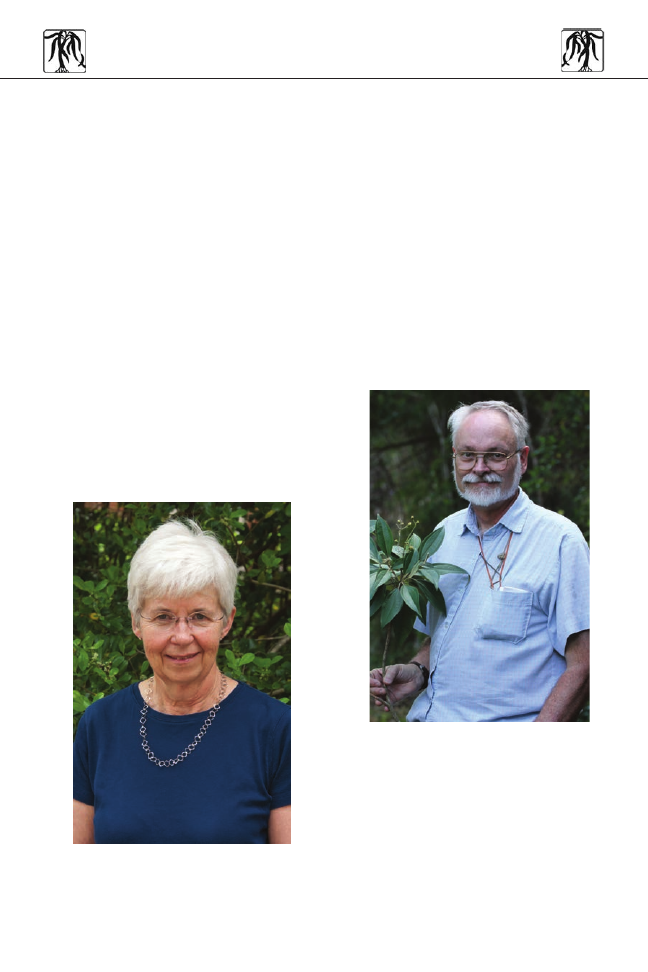
Dr. Patricia Gensel
University of North Carolina
Dr. Gensel is an international leader in the
investigation of early land plant evolution. Her
research, including rigorous field and laboratory
work, has contributed significantly to our
understanding of plant diversity at the time when
major lineages of land plants were emerging.
Through careful morphological and anatomical
investigations she has brought “to life” extinct
genera of early land plants and improved our
understanding of the ecosystems in which these
plants participated. She is active as Professor of
Botany at the University of North Carolina, where
she has taught since 1975 and has encouraged and
collaborated with many students and colleagues
internationally. Pat served as president of the
Botanical Society of America in 2000–2001,
during a time of great transition as the Society
began managing its annual Botany conferences
independently of AIBS.
Dr. Walter Judd
University of Florida,
Gainesville
Dr. Judd is recognized worldwide for his
contributions to plant systematics, taxonomy,
and phylogenetics. Although he is very well
known for his academic achievements, where he
has focused on the systematics of the Ericaceae
and Melastomataceae, as well as floristics in the
southeastern United States and the West Indies,
Dr. Judd is also an accomplished teacher, where

39
Plant Science Bulletin 58(2) 2012
at the University of Florida, he has been awarded
numerous times for his excellence in pedagogy. He
also has taught an internationally renowned class
in tropical botany for the past 30 years at Fairchild
Tropical Botanical Gardens and The Kampong in
Miami. Dr. Judd is the lead author of the influential
textbook, Plant Systematics: A Phylogenetic
Approach, which has been adopted throughout the
world as a model for teaching plant systematics and
taxonomy. Dr. Judd’s passion for teaching, research,
as well as learning, is ever influential to the graduate
and undergraduate students he mentors. The 2012
BSA Merit Award is a much-deserved honor for Dr.
Judd.
Dr. Richard Olmstead
University of Washington
Dr. Olmstead is recognized for his outstanding
contributions to reshaping the field of plant
systematics, including his leadership on the use
of chloroplast data in phylogenetic inference and
angiosperm classification. His doctoral research
with Melinda Denton resulted in a monograph of
the Scutellaria angustifolia complex (Lamiaceae).
His subsequent research on Asteridae has resulted in
major realignments in our understanding of family
boundaries in Lamiales (especially Lamiaceae and
Scrophulariaceae). He has published influential
papers on a broad range of issues in systematics.
Dick has guided the careers of numerous
undergraduates, graduates, and postdoctoral
fellows, fostered extensive collaborative
research activities, and made significant service
contributions to botanical and systematic societies.
The integration of his excellent research program
with public outreach activities through the Burke
Museum of Natural History and Culture and the
University of Washington herbarium serve as a
model for how we should be sharing our botanical
knowledge to improve the world.
Dr. Allison Snow
Ohio State University
Dr. Allison Snow is recognized for her outstanding
contributions to botanical science in the areas
of basic research, education, and professional
service. Allison’s research on pollination biology,
gene flow, and risk assessment of transgenic crops
represent significant contributions to the field. She
has mentored a number of students and researchers,
and has been a strong advocate for communicating
the importance of botany to the general public
via the media. Finally, Allison has been deeply
involved both nationally and internationally in
service to a variety of organizations, including the
National Academy of Sciences, the World Trade
Organization, and as president for the Botanical
Society of America.

40
Plant Science Bulletin 58(2) 2012
Darbaker Prize
The Darbaker Prize in Phycology is given each
year in memory of Dr. Leasure K. Darbaker. It
is presented to a resident of North America for
meritorious work in the study of microscopic
algae based on papers published in English by the
nominee during the last two full calendar years.
This year The Darbaker Award for meritorious
work on microscopic algae is presented to:
Dr. Walter Adey, National Museum of Natural
History, Smithsonian Institution. Dr. Adey has been
a pioneer of modern phycology. His development
of modern coralline taxonomy and the structural
analysis have provided the underpinnings for our
present understanding of this group that is now
being enhanced by molecular methods. He has
further pioneered the system of using filamentous
algae as scrubbers toward clean water production
and biofuels generation.
Dr. Sabeeha Merchant, University of California
at Los Angeles. Dr. Merchant has been instrumental
in developing the genetics and genomics
of Chlamydomonas as a model organism. Her work
has elucidated the role of metabolic cofactors and
iron and copper utilization in the biogenesis of the
photosynthetic apparatus, thus providing the basic
understanding of chloroplast development for
green algae and plants.
Vernon I. Cheadle Student
Travel Awards
(BSA in association with the Developmental and
Structural Section)
This award was named in honor of the memory
and work of Dr. Vernon I. Cheadle.
Allison Bronson, Humboldt State University.
Advisor: Dr. Mihai Tomescu. Botany 2012
presentation: “A perithecial sordariomycete
(Ascomycota) of diaporthalean affinity from the
Early Cretaceous of Vancouver Island, British
Columbia (Canada).” Co-authors: Ashley Klymiuk,
Ruth Stockey, and Alexandru Tomescu.
David Duarte, California State Polytechnic
University, Pomona. Advisor: Frank Ewers.
Botany 2012 presentation: “Plastic responses of
wood development in California black walnut
(Juglans californica): Effects of irrigation and post-
firegrowth.” Co-authors: Frank Ewers, Edward
Bobich, Shawn Pham, and Kristin Bozak.
Rachel Hackett, Central Michigan University.
Advisor: Dr. Anna Monfils. Botany 2012
presentation: “Prairie fen plant biodiversity: The
influence of landscape factors on plant community
assemblages.” Co-authors: Hillary Karbowski and
Anna Monfils.
Matthew Ogburn, Brown University. Advisor:
Dr. Erika Edwards. Botany 2012 presentation:
“Anatomy of leaf succulence in the clade
Portulacineae + Molluginaceae: Evolutionary
jumps into novel phenotypic space.” Co-author:
Erika Edwards.
Triarch “Botanical Images”
Student Travel Awards
This award provides acknowledgment and travel
support to BSA meetings for outstanding student
work coupling digital botanical images with
scientific explanations/descriptions designed for
the general public (see p. 47).
Glenn Shelton, Humboldt State University. 1st
place, A charismatic salt rush inflorescence, $500
Botany 2012 Student Travel Award.
Sean Gershaneck, University of Hawai’i at
Manoa. 2nd place, ‘Ōhi’a Lehua at Akanikōlea, $250
Botany 2012 Student Travel Award.
Andrew Crowl, University of Florida. 3rd place,
Cocos nucifera (coconut) dispersal in action, $150
Botany 2012 Student Travel Award.
The BSA Graduate Student
Research Award including the
J. S. Karling Award
The BSA Graduate Student Research Awards
support graduate student research and are made
on the basis of research proposals and letters of
recommendation. Within the award group is the
J. S. Karling Graduate Student Research Award.
This award was instituted by the Society in 1997
with funds derived through a generous gift from
the estate of the eminent mycologist, John Sidney
Karling (1897–1994), and supports and promotes
graduate student research in the botanical sciences.
The 2012 award recipients are:
J. S. Karling Graduate Student
Research Award
Matthew P. Nelsen, University of Chicago.
Advisor: Dr. Richard Ree. “Early, on time or
‘fashionably’ late? The comparative dating of lichen
symbionts.”

41
Plant Science Bulletin 58(2) 2012
BSA Graduate Student
Research Awards
Guadalupe Borja, Oklahoma State University.
Advisor: Dr. Andrew Doust. “Integrating phylogeny,
morphology, and population genetics: Investigating
species relationships in Paysonia (Brassicaceae).”
Louisa G. Carter, University of Georgia.
Advisor: Dr. Shu-Mei Chang. “Range limits and
conservation in species of a Florida endemic plant
genus, Polygonella.”
Gretel Clarke, University of Vermont. Advisor:
Dr. Alison K. Brody. “Assessing the effects of
pollinators, seed predators, and vertebrate
herbivores on the demography of females and
hermaphrodites in the gynodioecious plant,
Polemonium foliosissimum.”
Julieta Gallego, Museo Paleontológico Egidio
Feruglio. Advisor: Dr. N. R. Cúneo. “Analyses
of diversification rates of Patagonian Paleozoic
and Mesozoic lineages of gymnosperms through
calibration of molecular and morphological
phylogenies.”
Rachel M. Germain, University of Toronto.
Advisor: Dr. Benjamin Gilbert. “Evolution of
coexistence mechanisms in Mediterranean annual
plant communities.”
Rachel A. Hackett, Central Michigan University.
Advisor: Dr. Anna K. Monfils. “Influence of
landscape and local factors on plant communities.”
Kristen Hasenstab-Lehman, Rancho Santa
Ana Botanic Garden and Claremont Graduate
University. Advisor: Dr. Lucinda A. McDade.
“Testing adaptive radiation in the dry tropics:
A phylogenetic approach to biogeography,
inflorescence evolution, and hydraulic traits in the
genus Varronia (Cordiaceae, Boraginales).”
Laura Lagomarsino, Harvard University.
Advisor: Dr. Charles C. Davis. “Phylogeny and the
eolution of vertebrate pollination syndromes in the
Neotropical Lobelioideae, a rapid, recent radiation
in the Tropical Andes.”
Jacob B. Landis, University of Florida. Advisor:
Dr. Pamela S. Soltis. “Corolla length does matter:
Investigating genetic underpinnings of size.”
Vanessa Lopes Rivera, University of Texas at
Austin. Advisor: Dr. Jose L. Panero. “Reconstructing
the spatiotemporal evolutionary patterns of the
Brazilian Cerrado Eupatorieae and Lychnophorinae
(Asteraceae).”
Kristen Sauby, University of Florida. Advisor:
Dr. Robert D. Holt. “Determining the consequences
of herbivory by the invasive South American
cactus moth, Cactoblastis cactorum (Lepidoptera:
Pyralidae), to native Opuntia populations in
Florida.”
Brian J. Sidoti, University of Wisconsin-
Madison. Advisor: Dr. Kenneth M. Cameron.
“Molecular phylogenetics and population
genetics of the Tillandsia fasciculata complex
(Bromeliaceae): Biogeographical and evolutionary
implications.”
Sarah Tepler, University of California,
Santa Cruz. Advisor: Dr. Jarmila Pittermann.
“Understanding drivers of variability in the carbon
physiology of the giant kelp, Macrocystis pyrifera.”
Jinshun Zhong, University of Missouri-St. Louis.
Advisor: Dr. Elizabeth A. Kellogg. “The evolution
of floral symmetry across the order Lamiales.”
The BSA Undergraduate
Student Research Awards
The BSA Undergraduate Student Research
Awards support undergraduate student research
and are made on the basis of research proposals
and letters of recommendation. The 2012 award
recipients are:
Jenna Annis, Eastern Illinois University.
Advisor: Dr. Janice M. Coons. “Evaluating seed
ecology of federally threatened Pinguicula ionantha
(Godfrey’s butterwort).”
Ian A. Harkreader, Drake University. Advisor:
Dr. Nanci Ross. “Pollination biology and habitat
preference of a rare native lily, Lilium michiganense.”
Hillary Karbowski, Central Michigan University.
Advisor: Dr. Anna K. Monfils. “Local abiotic factors
and plant assemblages: An investigation into prairie
fen biodiversity.”
Caprice Lee, University of California, Davis.
Advisor: Dr. Sharman Diane O’Neill. “Novel
embryological study of Vanilla planifolia using
confocal scanning laser microscopy.”
Tess Nugent, University of Michigan. Advisor:
Dr. Selena Y. Smith. “Investigating potential causes
for variation in δ
13
C discrimination in Ginkgo
biloba.”
Jennifer O’Brien, Eastern Illinois University.
Advisor: Dr. Janice M. Coons. “Enhancing seed
germination and determining the seed bank of the
federally threatened Scutellaria floridana.”

42
Plant Science Bulletin 58(2) 2012
Bryan Thompson, State University of New
York at Plattsburgh. Advisor: Dr. Chris Martine.
“Hydroponic technology: The future of farming
and its ecological benefits: Growth rate response
and productivity of Ocimum basilicum and super
beefsteak tomato within a soilless environment
compared to a soil environment.”
The BSA Young Botanist
Awards
The purpose of these awards is to offer individual
recognition to outstanding graduating seniors
in the plant sciences and to encourage their
participation in the Botanical Society of America.
The 2012 Certificate of Special Achievement award
recipients are:
Rebbecca Allington, SUNY Plattsburgh.
Advisor: Dr. Christopher T. Martine
Jenna Annis, Eastern Illinois University.
Advisor: Janice M. Coons
Maggie Brown, Miami University. Advisor: Dr.
John Z. Kiss
April Diebold, University of Missouri. Advisor:
Dr. J. Chris Pires
Garrett Dienno, Miami University. Advisor: Dr.
John Z. Kiss
Chloe Drummond, Oberlin College. Advisor:
Dr. Michael J. Moore
Patrick Ellis, Vassar College. Advisor: Dr. Mark
A. Schlessman
Francisco Gomez, Florida Museum of Natural
History. Advisor: Dr. Pam Soltis
Monica Hernandez, University of California-
Los Angeles. Advisor: Dr. Ann Hirsch
Emilie Jordao, Central Michigan University.
Advisor: Dr. Joanne Dannenhoffer
Kelly Matsunaga, Humboldt State University.
Advisor: Dr. A. Mihail Tomescu
Britany Morgan, Rutgers University. Advisor:
Dr. Steven Handel
Jennifer O’Brien, Eastern Illinois University.
Advisor: Dr. Janice M. Coons
Gina Pahlke, Willamette University. Advisor:
Dr. Susan Kephart
Rachel Plumb, Oberlin College. Advisor: Dr.
Michael J. Moore
Audrey Ragsac, University of California.
Advisor: Dr. Paul Fine
Kendalee Richardson, Weber State University.
Advisor: Dr. Barbara Wachocki
Selina Ruzi, Rutgers University. Advisor: Dr.
Steven Handel
Megan Saunders, Hillsdale College. Advisor: Dr.
Ranessa L. Cooper
Jennifer Schmalz, Weber State University.
Advisor: Dr. Barbara Wachocki
Glenn Shelton, Humboldt State University.
Advisor: Dr. A. Mihail Tomescu
Christopher Steenbock, Humboldt State
University. Advisor: Dr. A. Mihail Tomescu
Lauren Stutts, Campbell University. Advisor:
Dr. J. Christopher Havran
Michael Terbush, Ohio University. Advisor: Dr.
Harvey E. Ballard Jr.
Weston Testo, Colgate University. Advisor: Dr.
James E. Watkins Jr.
Betty Unthank, Miami University. Advisor: Dr.
John Z. Kiss
Megan Ward, SUNY Plattsburgh. Advisor: Dr.
Christopher T. Martine
Tim Williams, Ohio University. Advisor: Dr.
Sarah E. Wyatt
Codi Q. Yeager, Cornell University. Advisor: Dr.
Lee B. Kass
Developmental & Structural
Section Student Travel Awards
Xiaofeng Yin, Miami University. Advisor: Dr.
Roger Meicenheimer. Botany 2012 presentation: “A
quantitative analysis of discontinuous phyllotactic
transition in Diphasiastrum digitatum.” Co-author:
Roger Meicenheimer.
Christina Lord, Dalhousie University.
Advisor: Dr. Arunika Gunawardena. Botany 2012
presentation: “Actin microfilaments: Key regulators
of programmed cell death (PCD) in the lace plant.”
Co-authors: Adrian Dauphinee and Arunika
Gunawardena.
Nelson Salinas, New York Botanical Garden.
Botany 2012 presentation: “Uncovering venation
patterns in neotropical blueberries (Vaccinieae:
Ericaceae) and their value for systematics.” Co-
author: Paola Pedraza-Peñalosa.

43
Plant Science Bulletin 58(2) 2012
Nicholas Miles, University of Florida. Advisor:
Dr. Pamela Soltis. Botany 2012 presentation:
“Virus-induced gene silencing in carnivorous
pitcher plants.”
Co-authors: Douglas Soltis and
Pamela Soltis.
Jacob Landis, University of Florida. Advisor:
Dr. Pamela Soltis. Botany 2012 presentation: “All in
the family: Pollination syndromes and floral traits
in the flowering plant family Polemoniaceae.” Co-
authors: Douglas Soltis and Pamela Soltis.
Genetics Section Student
Travel Awards
Michael McKain, University of Georgia.
Advisor: Dr. Jim Leebens-Mack, for the paper “The
effect of paleopolyploidy on genome evolution
in Agavoideae.” Co-authors: Norman Wickett,
Yeting Zhang, Saravanaraj Ayyampalayam, Richard
McCombie, Mark Chase, Joseph Pires, Claude
dePamphilis, and Jim Leebens-Mack.
Travis Lawrence, CSU Sacramento.
Advisor: Dr. Shannon Datwyler, for the paper
“Testing the hypothesis of allopolyploidy in the
origin of Penstemon azureus (Plantaginaceae).” Co-
author: Shannon Datwyler.
Mycological Section Student
Travel Awards
Wesley Beaulieu, Indiana University.
Advisor: Dr. Keith Clay, for the paper “Cosmopolitan
distribution of ergot alkaloids produced by
Periglandula, clavicipitaceous symbionts of the
Convolvulaceae.” Co-authors: Katy L. Ryan, Daniel
G. Panaccione, Richard E. Miller, and Keith Clay.
Eduardo Campana, Kent State University.
Advisor: Dr. Christopher Blackwood, for the paper
“Fungal communities of northeastern Ohio.”
Carla Harper, University of Kansas.
Advisor: Dr. Thomas N. Taylor, for the paper
“Antarctic wood-decay fungi in glossopteridalean
roots and stems.” Co-authors: Thomas Taylor and
Michael Krings.
Phytochemical Section
Student Travel Award
Rachel Meyer, City University of New York.
Advisor: Dr. Amy Litt. Botany 2012 presentation:
“Molecular and chemical differences among Asian
eggplants analyzed in a framework of their history
of utilization.” Co-authors: Bruce Whitaker and
Amy Litt.
Pteridological Section &
American Fern Society Student
Travel Awards
Amanda Grusz, Duke University. Advisor:
Dr. Kathleen Pryer. Botany 2012 presentation:
“Using next generation sequencing to develop
microsatellite markers in ferns.” Co-authors:
Michael Windham and Kathleen Pryer.
Stacy Jorgensen, University of Vermont.
Advisor: Dr. David Barrington. Botany 2012
presentation: “New insights into the heritage of
Pacific Northwestern polyploids in the genus
Polystichum (Dryopteridaceae).” Co-author: David
Barrington.
Meghan McKeown, University of Vermont.
Advisor: Dr. David Barrington. Botany 2012
presentation: “A molecular phylogeny based
on seven markers supports the inclusion of
the Australian monotypic genus Revwattsia
(Dryopteridaceae) in Dryopteris.” Co-authors:
Michael Sundue and David Barrington.
Weston Testo, Colgate University. Advisor:
Dr. James E. Watkins. Botany 2012 presentation:
“Comparative gametophyte ecology of the
American hart’s-tongue fern and associated fern
taxa: Evidence for recent population declines in
New York State.” Co-author: James E. Watkins.
The BSA PLANTs Grant
Recipients
The purpose of these awards is to offer individual
recognition to outstanding graduating seniors in the
plant sciences and to encourage their participation
in the Botanical Society of America.
Dominique Alvis, University of Maryland-
Baltimore. Dr. Mauricio Bustos
Haydee Borrero, Florida International
University. Dr. Suzanne Koptur
Maria Friedman, Humboldt State University.
Dr. Erik Jules
Erin Fujimoto, University of Hawaii at Manoa.
Dr. Tom Ranker
Victoria Hanna, University of California-Irvine.
Dr. Kailen Mooney
Sean Gershaneck, University of Hawaii at
Manoa. Dr. Pattie Dunn
Lauren Gonzalez, University of New Orleans.
Dr. Charles Bell

44
Plant Science Bulletin 58(2) 2012
Alexandria Igwe, Howard University. Dr. Mary
McKenna
Jamie Minnaert-Grote, George Mason
University. Dr. Andrea Weeks
Rylan Sprague, Black Hills State University. Dr.
Benjamin van Ee
Brittany Stallworth, Howard University. Dr.
Mary McKenna
Dori Thompson, Texas State University-San
Marcos. Dr. Garland Upchurch
Val Yerby, Texas State University-San Marcos.
Dr. Nihal Dharmasiri
BSA Student Activists Visit
Capitol Hill
Marian Chau (PhD candidate, University of Hawaii
at Manoa) is one of the current Student Representatives
on the BSA Board of Directors, and Morgan Gostel (PhD
student, George Mason University) is a BSA student activist
representing the DC area, and recently elected as the next
incoming Student Representative.
We recently attended Congressional Visits
Day, sponsored by the Biological and Ecological
Sciences Coalition (BESC), American Institute
of Biological Sciences (AIBS), and the Ecological
Society of America (ESA). On the first day, we
took part in a public policy training session, and
we visited Congress the next day. The training
session was great, with short informative talks from
Kei Koizumi (White House Office of Science and
Technology Policy), Jane Silverthorne (NSF), and
Julie Palakovich Carr (AIBS) that gave information
on the national budget from different perspectives.
Nadine Lymn and other folks from ESA oriented
us for the Congressional meeting experience, and
then we met with our smaller groups to plan the
next day. Morgan was with other folks from mid-
Atlantic states, and Marian was placed with Florida
(I suppose we were the tropical contingent!).
Marian’s Experience
Our Hawaii/Florida team was led by Liza Lester,
ESA Communications Officer, who facilitated our
day of meetings. One of our Florida constituents
actually didn’t show up, so it was just Liza,
Adam Rosenblatt—a grad student from Florida
International University who does ecology in the
Everglades—and myself. I actually really enjoyed
being in the small group, and the three of us became
friends who will definitely stay in touch.
We visited all of the Hawaii and Florida
senators’ offices, and a few representatives’ offices.
I led meetings with Hawaii’s congressional staff,
and Adam led meetings with Florida’s. As you can
imagine, that made for a full and hectic day of
meetings—we walked back and forth between the
Senate and the House office buildings a lot, walking
past the Capitol at least four times!—but it was
really fun, too. Hawaii’s Congressional members
are all Democrats, so not too surprisingly they
were quite supportive of science, research, and the
President’s proposed budget that would increase
funding for NSF to $7.3 billion (4.8%) in FY 2013.
Beyond that, what was interesting and encouraging
to me was that the legislative assistants I spoke with
were generous with their time and were happy
to talk to me, and to learn about things such as
research at UH Botany, our recently NSF-funded
Consortium of Pacific Herbaria, and rare plant seed
storage at Lyon Arboretum in Hawaii. They seemed
eager to learn more about how NSF directly benefits
our state. I also talked to a couple of them about
PlantingScience, and what an excellent investment
of NSF funding that has been for making strides
in STEM education, along with how NSF funding
has benefited other BSA students. Because Hawaii
Sen. Daniel Inouye is now the Chairman of the
Appropriations Committee, it is great to know that
he is a strong proponent of funding for scientific
research.
Being present for the meetings with Florida
congressional staff was very interesting too. The
Democrats were again supportive of increasing
funds to NSF, but even the Republicans were at
least generally supportive of scientific research and
open to talking to us. Only one was not supportive
of increases (Rep. Cliff Stearns, R-FL), but at least
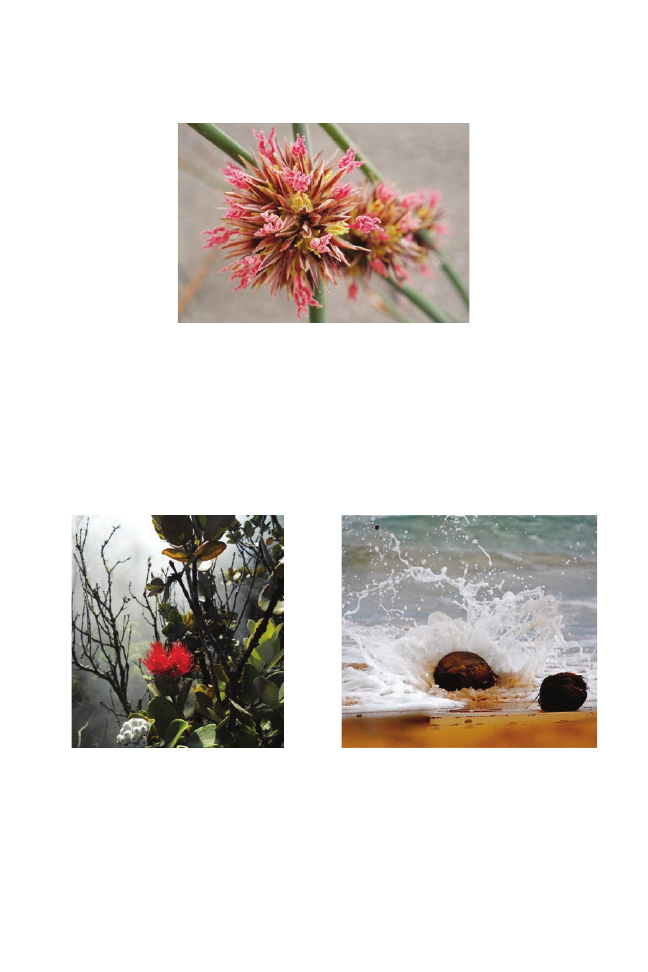
Marian Chau sitting at the desk of Senator Akaka, one of
her Hawaii Congressmen, after meeting with a staffer

45
Plant Science Bulletin 58(2) 2012
already planning to visit directly with my congress-
people when they are home for August recess) and
will encourage other BSA students to get involved,
starting with our workshop at Botany 2012.
Morgan Gostel (far right) with other members of the
Mid-Atlantic team visiting Capitol Hill.
Morgan’s Experience
Overall, I had the same sentiments as Marian and
was also quite impressed with how welcoming and
generous congressional staff were with their time.
My group included constituents from Maryland,
Pennsylvania, and Virginia and was led by the ESA
Director of Public Affairs, Nadine Lymn. Our Mid-
Atlantic delegation included graduate students,
a postdoc, and the current president of the ESA,
Steward Pickett. We met with congressional staffers
for both of the state senators from Pennsylvania
and Maryland and one from my home state (Mark
Warner, D-VA). Each of us also had meetings with
our local state representatives, with whom we are
constituents; a couple of folks in my regional group
actually had a chance to speak directly with their
representative! In all cases, the meetings were well
received and there were opportunities to exchange
research anecdotes that related directly to the
central issue: funding science is important!
Some offices were, of course, more receptive
than others, and there seemed to be a universal
concern with uncertainty over budget priorities.
Being an election year, it was suggested that budget
understood the importance of scientific research
and did not want to decrease funds to NSF. He was
honest about his doubts that Congress would even
manage to pass a budget before the new fiscal year,
and thought that we’d be pretty lucky to get one that
keeps funding level, but hey, he’s just being a realist.
The legislative director for Sen. Marco Rubio (R-
FL) was a happy surprise, as we had a very friendly,
entertaining, and productive meeting with her. Not
only was she strongly in support of NSF funding,
she was also generous with her time and even
traded personal stories with us.
The variety of congressional staff we spoke with
was interesting. One was an AAAS Congressional
Fellow and an oceanographer, and it was great
talking to another scientist. Other legislative
assistants specialized in areas such as education,
energy, and financial services, and the legislative
director I mentioned before (for Rubio) was
actually pretty high up in the chain of command—
and you could tell she had a lot more experience.
Also interesting were the differences between the
House and Senate. House offices were smaller and
seemed to be rather hectic and less organized.
At all of these meetings, we were sitting with the
staffer in the office lobby, sometimes with several
other things going on around us. Senate offices
tended to be much larger, labyrinthine even, with
a lot more staff, and we always met in conference
rooms or offices. Although I was disappointed
that my planned meetings with my actual senators
didn’t pan out, we did get to meet with Sen. Daniel
Akaka’s (D-HI) staffer in the senator’s office—and
we got a fun photo op of me sitting at his desk. After
our meetings were done, Liza, Adam, and I went
back to the Capitol to visit the House gallery. By
this time it was after 5 pm, and amusingly we got
to watch a congressman give a passionate speech
to an almost entirely empty House floor—if that’s
not a metaphor for something, I don’t know what
is! After that, Liza and I met up with Morgan
over happy hour to decompress and trade some
stories. An exhausting but productive, educational,
entertaining, and great day.
I would like to thank BSA for sponsoring me
to attend this event! It was just a great experience
overall. Not only did I learn a lot about how
Congress works (and doesn’t!), I also got some great
practice at being a “people person” and interacting
with folks who have some influence on the country’s
purse strings—as well as other science activists. I
will definitely stay involved in public policy (I’m

46
Plant Science Bulletin 58(2) 2012
issues probably would not be confronted in earnest
until later in the year, closer to November and
December. In most cases we were encouraged not
to let this event be a one-off and to remain involved
in scientific policy issues as they arise, even if it just
means calling in to clarify a point or error made
on a radio show or writing to encourage support
of relevant legislative issues when they are coming
up for a vote. Of course, the simplest way to have
your voice heard is just to vote each November. As
a student myself, I frequently hear fellow students
mention that they either have not updated their
voter registration or in many cases do not vote as
an absentee (yes, we’re usually far from home).
We’ve recently seen how much of an impact young
voters can have and it’s important to stress the value
of your vote and encourage your fellow students to
vote as well!
Overall, the Congressional Visits Day was a great
experience and I was glad to have the opportunity
to represent the BSA! I owe a huge thanks to Marian
for asking me if I’d like to participate and also to
the ESA, BESC, and AIBS for organizing such an
important event. I look forward to staying involved
with AIBS and BSA, and science policy issues.
To conclude, we both strongly encourage
students/postdocs to get more involved in public
policy issues that concern botany and other
biological sciences. A very easy way to start is to
join AIBS’s Action Center online: http://capwiz.
com/aibs/home/. You’ll receive action alerts when
important issues come up, and you can make a
difference simply by writing your congresspeople
through AIBS’s easy interface. If you want to make
a bigger impact, please register for our Botany 2012
Workshop: “Influencing Science Policymakers: A
Workshop for Students and Early Career Scientists”
(WS12, Sunday, July 8, 3:15–5:15 pm). Registration
is free for students and early career scientists,
courtesy of BSA.
Your current BSA Student Reps (Marian and
Megan) also have great news. At the BSA board
meeting in April, we proposed a new BSA Public
Policy Award that will support two students
to attend Congressional Visits Day each year
(including travel and accommodation expenses;
the training/meeting support are provided
free of charge by AIBS). The BSA Board voted
unanimously to establish this new student award
beginning in 2013!
-Marian Chau and Morgan Gostel
Marian Chau with a fellow grad student activist
(the Hawaii-Florida team) visiting Capitol Hill.
47
Plant Science Bulletin 58(2) 2012
2012 Triarch “Botanical Images”
Student Travel Award Winners
A charismatic salt rush inflorescence
Glenn Shelton, Humboldt State Univeristy
Rushes and other grass-like plants are frequently overlooked amidst a landscape of showy entomophilous
(insect-pollinated) flowers. However, up close their inflorescences can be far from drab. The flowers of this
coastal Juncus species, J. breweri (salt-rush), possess elaborate stigmas bearing vivid pink lobes, looking
very much like ornamented pink corkscrews. Like many other flowering plants, rushes are anemophilous
(wind pollinated). Anemophilous flowers tend to lack showy sepals and petals like those of their insect-
pollinated relatives and instead opt for large exserted anthers and stigmas, and small pollen grains that
are easily carried by the wind. The helical stigma lobes of these salt-rush flowers likely provide optimal
surface area for pollen receipt.
Ōhi'a Lehua at Akanikōlea
Sean Gershaneck,
University of Hawai'i at
Manoa
Ōhi’a Lehua (Metrosideros polymorpha)
is Hawai’i’s most common native tree with a
distribution ranging from coastal forests to the
treeline on some of the world’s tallest mountains
as well as bogs, swamps, and deserts.
Cocos nucifera (coconut)
dispersal in action
Andrew Crowl
University of Florida
Cocos nucifera is the only species in the Cocos
genus (Arecaceae: palm family). It is a primarily
coastal species found throughout the tropics and
subtropics.

48
“The mentors posed great questions and were very
approachable. It seemed like the students were able
to relate to them.”
“Despite being a long time period to commit to one
inquiry, I felt it benefited the students in a number
of ways. First, their ownership and responsibility
was heightened and very evident. Second, they were
thinking and discussing at a level much deeper than
any activity prior to this experience. As a teacher, it
allows me to do true open-ended student-generated
inquiry which is nice.”
Mentor feedback:
“It has provided a benefit in that it counts as
service for me in my job, but more importantly I can
directly help students become better thinkers, which
benefits everyone.”
“I think that learning how to talk to different
levels to students (I am a college professor) helps my
teaching at many levels.”
“It is a lot of fun interacting with students from an
age group I don’t have the chance to spend a lot of time
with. It is a good reminder of where public knowledge
of plant science stands, and a great opportunity for
me to practice explaining key concepts in a simple
and straightforward way.”
As these quotes suggest, there is a special magic
at work when students, teachers, and scientist
mentors engage in collaborations. We are currently
working on major improvements to the website
that will enhance the user experiences. And we
are excited to be working more closely with the 14
partner societies and organizations as the program
plans for the future.
BSA Science Education
News and Notes
PlantingScience
As the spring PlantingScience session ends, almost
12,000 middle and high school science students
and their teachers have collaborated on plant
investigations. Thanks to the Master Plant Science
Team, sponsored by the Botanical Society of
America and American Society of Plant Biologists,
and the >560 scientists who have volunteered as
online mentors since 2005. Students value the
chance to work hands-on with plants and connect
with scientists online. Here are some of the benefits
in the words of a few participants.
Student feedback:
“What I liked most about this experience is learning
about the different traits in a plant and watching the
plant grow.”
“It was fun to be able to interact with an actual
scientist about the experiment and learn new things.
He helped us to point our many things that we would
have never noticed on our own and it was very
helpful.”
“I liked having to figure things out on my own or with
my group and figuring out why things happened and
finding out what would happen if we did this or that.”
“The thing I liked most was being able to talk to a
scientist about what we were doing, and he gave us
helpful suggestions on how to do things. Our scientist
also asked us questions on what we were doing that
helped us keep our minds working.”
Teacher feedback:
“PlantingScience has given me a framework for
open inquiry. Students enjoy working with their
mentors and it gives each group a chance to have
some one-on-one feedback that I don’t always have
time to give them. Students embrace their projects
more than anything else I do in the class and when
they give their final presentations, important topics
such as finding that similar results are often found
between different groups who did similar experiments
to show students how bodies of evidence are built up
by multiple people studying similar topics.”
BSA Science Education News and Notes is a quarterly update about the BSA’s education efforts and the
broader education scene. We invite you to submit news items or ideas for future features. Contact: Claire
Hemingway, BSA Education Director, at chemingway@botany.org or Marshall Sundberg, PSB Editor, at
psb@botany.org.

49
Plant Science Bulletin 58(2) 2012
International Graduate School
Applications Static in the Life
Sciences
Foreign student applications for fall 2012
admissions to U.S. graduate schools saw no growth
in the life sciences. In contrast, applications
increased over last year for all other fields. For
example, education rose by 17%, engineering
increased by 12%, and the arts and humanities
rose by 4%. The top five countries of origin for
international graduate students are China, India,
South Korea, Taiwan, and Canada. The full report
of the 242 institutions by the Council of Graduate
Schools is available online at:
http://www.cgsnet.org/international-graduate-
applications-rise-seventh-consecutive-year-china-
mexico-and-brazil-show-large.
Faculty Leakage by Gender and
the 11-Year Itch
Although male and female faculty are retained
and promoted at similar rates, the good news from
a recent Science article ends there. Less than 50% of
science and engineering faculty hired are retained
over the long term. These departing tenure-track
faculty exit at a median of 10.9 years. The low
retention rates pose significant direct impact costs
and can led to disruption at universities. Expanding
current trends of women hires and retention to
a long-term view, the authors note that gender
equality in science, technology, engineering, and
math (STEM) departments could still be 100 years
away.
Read an article from the Chronicle of Higher
Education on the Science article and a related article
in American Scientist:
http://chronicle.com/article/Gender-Equity-on-
Science/130839/
See a video of Prof. Deborah Kaminski, one of
the study coauthors, talking about the study at:
http://www.youtube.com/watch?v=vIJOvIqHymA
Education Bits and Bobs
Scores up, inclusion down, and
gender preferences in AP courses
Females take the AP Biology test in higher
numbers than males. This is one of the noteworthy
statistics included in the College Board’s 8th annual
report on the Advanced Placement program. The
finding may have implications down the pipeline.
Research shows that students who take AP science
exams are more likely to earn science degrees.
The decade-long trend for increasing numbers of
students taking and succeeding on the AP exams
is also promising. However, of the STEM exams,
scores are lowest for Biology and Environmental
Science. Across all subject areas, underserved
minority and low-income students are significantly
underrepresented in AP classrooms. Access the
report online:
http://apreport.collegeboard.org/report-
downloads
Read a related story: http://blogs.edweek.org/
edweek/curriculum/2012/02/girls_like_biology_
boys_like_p.html
Can Reimagining Community
Colleges Reclaim the American
Dream?
Educating an additional five million students by
2020 is an overall goal of a report released by the
American Association of Community Colleges.
The report is a roadmap for dramatic changes to
community colleges to ensure their role in preparing
students for education and workforce pathways.
Currently, many students arrive at community
colleges unprepared and take at lease one remedial
course. Recommendations in the report suggest
reforms to redesign students’ experiences, reinvent
institutional roles, and reset the system to promote
rigor, transparency, and success.
Access the online report:
http://www.aacc.nche.edu/
AboutCC/21stcenturyreport/index.html
Read a related story: http://blogs.edweek.
org/edweek/college_bound/2012/04/to_move_
community_colleges_ahead.html?cmp=ENL-EU-
NEWS2

50
An Antique Microscope Slide Brings
the Thrill of Discovery into a Con-
temporary Biology Classroom
Riser, Frank. 2012.
American Biology Teacher
74(5): 311-317.
The author purchased a “folk art” handmade
microscope slide from around 1890 from an on-
line antique dealer. The slide contained 90 different
angiosperm seeds, and other propagules, in an
artistic arrangement. Of course there was no key
to the species represented—thus the challenges to
students. How many of these seeds can we identify?
In addition to a beautiful color close-up photo of
the slide, there are 10 more sharply detailed images
of seeds and seed characters. If you don’t subscribe,
it is worth a trip to the library just to see the images!
Exploring Undergraduates’ Under-
standing of Photosynthesis Using
Diagnostic Question Clusters
Parker, J.M., Anderson, C.W., Heidemann,
M., Merrill, J., Merritt, B., Richmond, G., and
M. Urban-Lurain. 2012. CBE Life Sciences
Education 11(1): 47-57.
The authors present an assessment tool that focuses
on common, well-documented misconceptions
about photosynthesis and energy relationships in
plants from the sub-cellular through ecosystem
levels. They demonstrate that properly constructed
groups of multiple choice/true-false questions can
be as effective at identifying student misconceptions
as the more rigorous qualitative techniques of
interviews and open-ended essays. Questions,
and student responses, are summarized in the
appendices.
Backyard Botany: Using GPS Tech-
nology in the Science Classroom
March, K.A. 2012. American Biology Teacher
74(3): 172-177.
I work with Boy Scouts a lot and geocaching has
become the latest thing in teaching orienteering.
The kids love it. The author takes the idea of
geocaching and adapts it to field use for finding and
identifying trees. Adding the GPS makes keying out
the trees much more palatable than the old walk-
around. Why not make it a game? Sometimes we
need all the help we can get to make learning fun!
Editors Choice Reviews

51
Personalia
Past-President Karl Niklas
Named One of “Best 300
Professors”
Random House/Princeton Review Books in-
cluded BSA Past-President Karl Niklas as one of the
17 biologists recognized in their recently published
book, The Best 300 Professors. The Princeton Review
teamed with the online site RateMyProfessors to
identify popular professors and combined this with
information from its own surveys and information
from individual colleges to narrow the list to 300.
For some inspiring comments, check out Karl at
http://www.ratemyprofessors.com. He doesn’t rate
very high on “easiness,” but he certainly inspires his
students (and even gets a “hot” rating!).
BSA Election Results
Congratulations to the newly elected officers of the Botanical Society of America
Pam Diggle
President-Elect
Andrea Wolfe
Secretary
Morgan Gostel
Student
Representative
Susan Singer
Director
at Large -
Education
52
Meetings and Conferences
The Legacy Society of the Botanical Society of
America hosted its first regional event in April in
Saint Louis.
Hosted by two of the Legacy Society’s
founders, Drs. Peter and Pat Raven, this very special
evening took place at the historic Chase Park Plaza
Hotel for a night of dinner, drinks, and unique
presentations to honor and recognize the vital
contributions and service of individual BSA
members.
For those of you who may not be familiar with
the BSA’s Legacy Society, the concept for the group
came together during centennial celebrations at
the Botany 2006 Conference in Chico, California.
Senior members of the Society, together with the
Development Committee, determined it was time
to build upon the legacy of giving initiated by
our predecessors. This handful of Legacy Society
founders truly understood the importance of
building and growing an active group to create
a sustainable financial future for the BSA. They
demonstrated their appreciation for the over 100
years of the Society’s history, and all that the Society
has done for its members and the botanical sciences
through planned legacy gifts.
In just over six years, the Legacy Society has
quietly nurtured the vision and has grown its
membership to more than 70 individuals
.
The
generous, individual commitments made by
members of the group will secure the future for
the BSA in its mission to provide members with
research opportunities, conferences, publications,
and awards that help build the careers of young
scientists.
Last year, the Legacy Society felt it was
long overdue that we regularly celebrate the
important individual contributions made
by some of our members and began plans
to sponsor Legacy Society Celebrates events
in regions throughout the country. At this
first event in the Central States region,
historian Dr. Vassiliki
Betty Smocovitis and
current American Journal of Botany editor
Dr. Judy Jernstedt provided enlightening
presentations about the rich history of the
AJB and the BSA.
Saint Louis member
and Assistant Professor of Biology at
Saint Louis University Dr. Allison Miller
The Legacy Society Celebrates
A night that recognized, honored, and applauded
individual service to the
Botanical Society of America
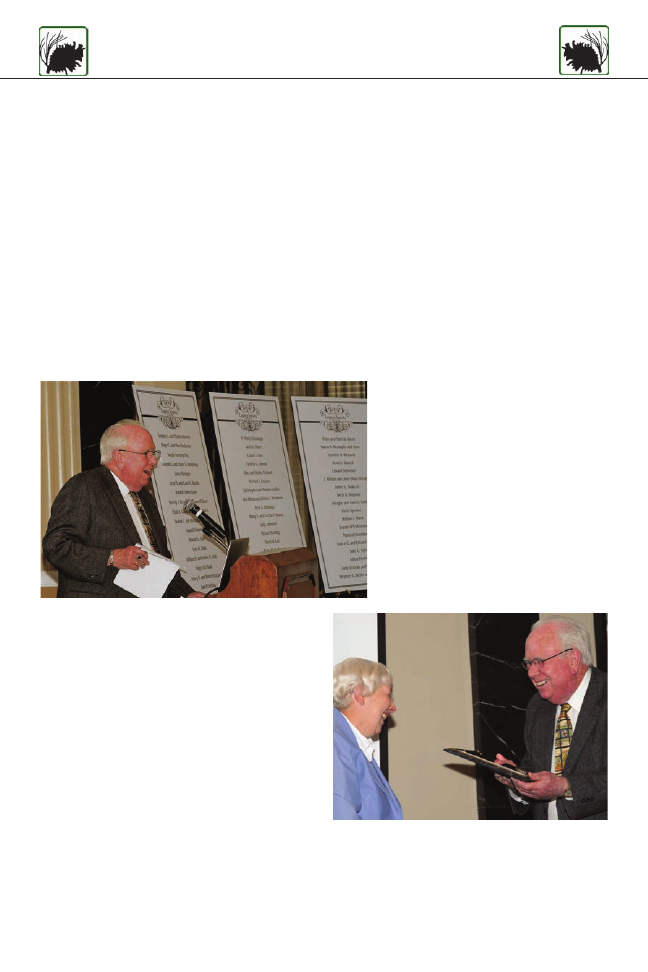
Dr. Judy Jernstedt receives a plaque for her service
as Editor of the American Journal of Botany.
Dr. Peter Raven addresses the BSA Legacy Society.

53
Plant Science Bulletin 58(2) 2012
demonstrated in her presentation, “Botany in
the Next Generation: Advancing Plant Science
on the Shoulders of Giants,” that the botanical
sciences continue to progress, and that our legacy
is based on a foundation of scientific discovery
passed on from generation to generation. She also
shared how society in general is benefiting from
the dynamic impact and breadth of new genomic
research on the future of our field.
And, since we are approaching the cusp of the
centennial for the American Journal of Botany,
the event was also an opportunity to individually
recognize the service and dedication of our former
and current AJB editors, Drs. Judy Jernstedt, Karl J.
Niklas, Nels R. Lersten, and Theodore Delevoryas.
We thanked them for all that they have contributed
to our Society, and to the development of botanical
sciences.
Finally, the Legacy Society honored its own.
Attending Legacy Society members from the
Central States region were recognized and
applauded for their long-standing commitment,
vision, and financial generosity toward the future of
the BSA. It was truly heartwarming to be a part of
this first Legacy Society Celebrates event.
The BSA has a long tradition of member
commitment and support for everything we
do—from our annual conferences, publications,
education, and outreach programs, to student
awards, lecture funds, and so much more. We
look forward to our next Legacy Society Celebrates
event scheduled to take place on the East Coast,
where additional members will be recognized for
their unique contributions to our Society.
The important foundation of support our
Legacy Society members have provided for the
future of the BSA is truly a testament to their life-
long commitment to our mission, and they carry
forth the tradition of giving that our predecessors
envisioned.
To learn more about becoming a BSA Legacy
Society member, please go to
http://www.botany.
org/legacy/
. We’d be honored to have you participate
in our future!
Dr. Linda Graham
Board Member & Chair, BSA Development Com-
mittee
Dr. Allison Miller shares her presentation, “Botany
in the Next Generation: Advancing Plant Science on
the Shoulders of Giants.”
Dr.Vassiliki
Betty Smocovitis recounts a brief history
of the Botanical Society of America.

54
Plant Science Bulletin 58(2) 2012
Celebrating 30 Years of
the Flora of the Bahamas:
Conservation and Science
Challenges
An International Symposium
(October 30-31, 2012) at the Bahamas
National Trust and The College of
the Bahamas
The Bahamas National Trust, the College of
the Bahamas, Fairchild Tropical Botanic Garden,
and Florida International University are putting
together a symposium titled “Celebrating 30 Years
of the Flora of the Bahamas: Conservation and
Science Challenges,” which will take place between
October 30 and 31, 2012. This announcement is to
invite those interested in Bahamian biodiversity to
attend the symposium. We will have a section for
posters and we would like to encourage researchers
and graduate students to present their results using
this avenue. We also have plans to publish the
symposium proceedings in the Caribbean Journal
of Science and, in coordination with the Editor-
in-Chief of this journal (Dr. David L. Ballantine),
the scientific committee will be processing the
submissions (see following submission deadline
details). This announcement and new developments
about the symposium will be posted regularly at
http://www.fairchildgarden/bahamas.
1. Scientific Committee:
Dr. Javier Francisco-Ortega (Associate Professor,
Florida International University and Fairchild
Tropical Botanic Garden)
Dr. Ethan Freid (Botanist, Bahamas National
Trust)
Dr. Brett Jestrow (Herbarium Curator, Fairchild
Tropical Botanic Garden)
Dr. Dion Hepburn (Chair, School of Chemistry,
Environmental & Life Sciences, College of the
Bahamas)
2. Organizing Committee:
Tamica Rahming (Director of Science and Policy,
Bahamas National Trust)
Eric Carey (Executive Director, Bahamas
National Trust)
Dr. Dion Hepburn (Chair, School of Chemistry,
Environmental & Life Sciences, College of the
Bahamas)
Dr. Javier Francisco-Ortega (Associate Professor,
Florida International University and Fairchild
Tropical Botanic Garden)
3. Symposium Background:
Sponsored by Fairchild Tropical Botanic Garden
and the U.S. National Science Foundation, the latest
comprehensive flora of the Bahama Archipelago
was published in 1982. This project was initiated by
William T. Gillis, but the final work was authored
by Donovan Correll and Helen Correll (illustrated
by Priscilla Fawcett). Since its publication, 30
years ago, this flora has played a major role in
Bahamian education, research, and conservation
because it is still the best available catalogue
for plant biodiversity of this archipelago. The
Bahamas National Trust has a mandate for plant
conservation management in the Commonwealth
of the Bahamas, and in the last 30 years it has been
using this flora as the “manual” for its floristic
activities. However, after recent discussions
between conservation biologists involved in the
symposium, we believe the time has arrived to
evaluate what we know about plant biodiversity in
the Bahamas and what conservation and research
challenges lie ahead. After these discussions we
feel that the 30th anniversary of the publication
of the Flora of the Bahama Archipelago will be a
good moment to organize a symposium to discuss
these issues in an open arena. In the last 30 years
many new research tools have been developed, but
we also have many new environmental challenges.
This is particularly relevant in the Bahamas, where
in the last 30 years: (1) a network of national parks
has been established, and (2) new botanical gardens
with a strong conservation mission have been
recently created or are about to be established.
4. Symposium Agenda:
October 30 (Tuesday):
Morning and afternoon at the College of
the Bahamas (New Library of Oakes Field
Campus, Thompson Boulevard). Oral and poster
presentations (see following list of speakers and
agenda).
October 31 (Wednesday):
A. Morning: Field-trip (tentative depending on
number of interested participants and available
funding) to visit at least one of the New Providence
national parks (Primeval Forest National Park
and/or Harold and Wilson Ponds National Park);
led by Ethan Freid. We are not certain about the
number of slots that we will have available in the

55
Plant Science Bulletin 58(2) 2012
6. Symposium Fees/Registration,
Accommodation, Abstract, Poster, Proceeding
Guidelines:
6.1. There are no symposium attendance fees.
We are aiming for school teachers to also attend
the symposium; therefore, the event aims to have
a strong community and outreach component. To
register for the symposium, send an e-mail to Javier
Francisco-Ortega at ortegaj@fiu.edu. We would also
appreciate receiving details of: (1) the hotel where
you will stay, (2) if you plan to join the field trip to
the National Park (October 31), (3) if you plan to
attend only the symposium talks at the College of
the Bahamas (October 30), (4) if you plan to attend
only the reception at the Retreat (October 31), and
(4) if you plan to attend the activities offered both
at the College of the Bahamas and at the Bahamas
National Trust (October 30 and 31).
6.2. There are no hotels near the College of the
Bahamas or the Retreat Gardens. However, there
are several hotels along W Bay Street and Bay Street
where you should be able to find accommodation.
We are planning to provide transportation from a
designated point near the hotel area to the College
of the Bahamas and to the Retreat. A passport is
required to travel to the Bahamas, but visa is not
needed for U.S. citizens and legal residents.
Potential hotels are:
British Colonial Hilton - Nassau (Number One
Bay St., Nassau N 7148, Bahamas, Phone: (242)
322-3301)
Towne Hotel (40 George Street, Nassau PO BOX
N-4, Bahamas, Phone: (242) 322-8451)
Nassau Palm Hotel (West Bay Street, Nassau
19055, Bahamas, Phone: (242) 356-0000)
El Greco Hotel (West Bay Street, Nassau,
Bahamas, Phone: (242) 325-1121)
Nassau Junkanoo Resort (West Bay & Nassau
Street, Nassau, 8191, Phone: (242) 322-1515)
There are also several hotels near the airport,
but transportation from this area to Nassau is not
inexpensive.
6.3. Abstracts of posters and lectures from
speakers should be send by e-mail to Javier
Francisco-Ortega at ortegaj@fiu.edu before
September 15, 2012. Each abstract should have a
maximum of 250 words. Although the talks of the
symposium have a focus on the Bahamian flora,
buses; therefore, please indicate in your registration
e-mail if you are interested in joining this field trip.
Participants will be registered for this field trip on a
first-come, first-served basis.
B. Afternoon (starts at 5:00 PM). Reception at
the Retreat Gardens, Headquarters of the Bahamas
National Trust.
B.1. Tour to the garden living collections; led by
Ethan Freid.
B.2. Welcome words by Neil McKinney, President
of Bahamas National Trust.
B.3. Lecture: “Bahamas National Trust Program
to Advance Botanical Education, Research, and
Conservation” by Eric Carey (Executive Director of
the Bahamas National Trust)
5. Oral/Poster Presentations and Speakers
(Symposium, October 30):
1. Dion Hepburn: Welcome words
2. Javier Francisco-Ortega: Introduction to the
symposium
3. Keynote speaker: W. Hardy Eshbaugh, Miami
University (Peter Raven Award recipient, 2008):
“The Flora of the Bahamas, Donovan Correll, and
the Miami University Connection”
4. Ethan Freid: “Plant Endemicity on the Bahama
Archipelago”
5. Lee B. Kass, Cornell University: “Historical
Aspects of Correll & Correll’s flora of the Bahama
Archipelago”
6. Michael Vincent, Miami University:
“Systematics, Taxonomy, and the new Flora of the
Bahamian Archipelago”
7. Brett Jestrow: “From Plant Exploration to
Phylogenetic and Biogeograpical Studies in the
Bahamas”
8. Eric Carey, Director of the Bahamas National
Trust: “Plant Conservation Challenges in the
Bahamas”
9. Carl Lewis, Director of Fairchild Tropical
Botanic Garden: “Establishing Bridges Between
Science, Education, Community Involvement, and
Conservation”
10. Poster Presentations

56
Plant Science Bulletin 58(2) 2012
we want the symposium to also be an opportunity
for biologists and environmental scientists to show
their results. Therefore, we welcome posters in any
area of environmental biology pertinent to the
Caribbean Islands and South Florida, including
both marine and terrestrial systems. Abstracts will
be posted in the website of the symposium as we
receive them.
6.4. Posters should not be more than 4 feet (121
cm) wide by 4 feet (121 cm) high.
6.5. The deadline to submit manuscripts to
the Caribbean Journal of Science is December 16;
however, we encourage participants to send their
submissions to this journal just around the time
of the symposium. We will have a limited number
of pages for the issue of the Caribbean Journal of
Science devoted to the symposium proceedings.
Manuscripts need to be sent to the Editor-in-Chief
of the journal, Dr. David L. Ballantine, at david.
ballantine@upr.edu. Please indicate in the cover
letter that the manuscript is part of the symposium
proceedings.
MISSOURI BOTANICAL GARDEN
ETHNOBOTANISTS RECEIVE
NATIONAL GEOGRAPHIC
SOCIETY GRANT FOR STUDY AT
CROW CREEK INDIAN
RESERVATION
Project Explores Traditional
Ecological Knowledge of the
Dakota Sioux People
ST. LOUIS, MO—The National Geographic
Society’s Committee for Research and Exploration
has awarded a one-year, $15,150 grant to Dr. Wendy
Applequist, an ethnobotanist at the Missouri
Botanical Garden’s William L. Brown Center,
who will collaborate with fellow ethnobotanist
Karen Walker and Peter Lengkeek, tribal member
of the Crow Creek Indian Reservation, to collect
information about the traditional ecological
knowledge of the Dakota Sioux People living on
the Crow Creek Indian Reservation in central
South Dakota. Native Americans have accumulated
knowledge about their environment for centuries,
developing skills in using plants that grow around
them for food, medicine and shelter. Faced with
an overwhelming potential for this knowledge to
be lost in our modern society, project organizers,
together with tribal members, seek to empower
communities within the reservation to promote
the preservation and use of traditional ecological
knowledge.
Historically, Native Americans have passed
their knowledge from one family to the next
through oral traditions of storytelling, songs and
teaching. Traditional Ecological Knowledge (TEK)
is a rich part of the cultural heritage of the Dakota
People, who have used the prairie bioregion’s flora
and fauna for food, medicine, dyes, ceremonies
and building materials. In recent times, tribal
members have grown concerned that their valuable
traditional knowledge is being lost as community
elders pass away. Together with former tribal
council member Lengkeek, the Missouri Botanical
Garden designed a research plan to document
the native plant knowledge of their reservation to
ensure this knowledge is continuing to be passed
on for future generations.
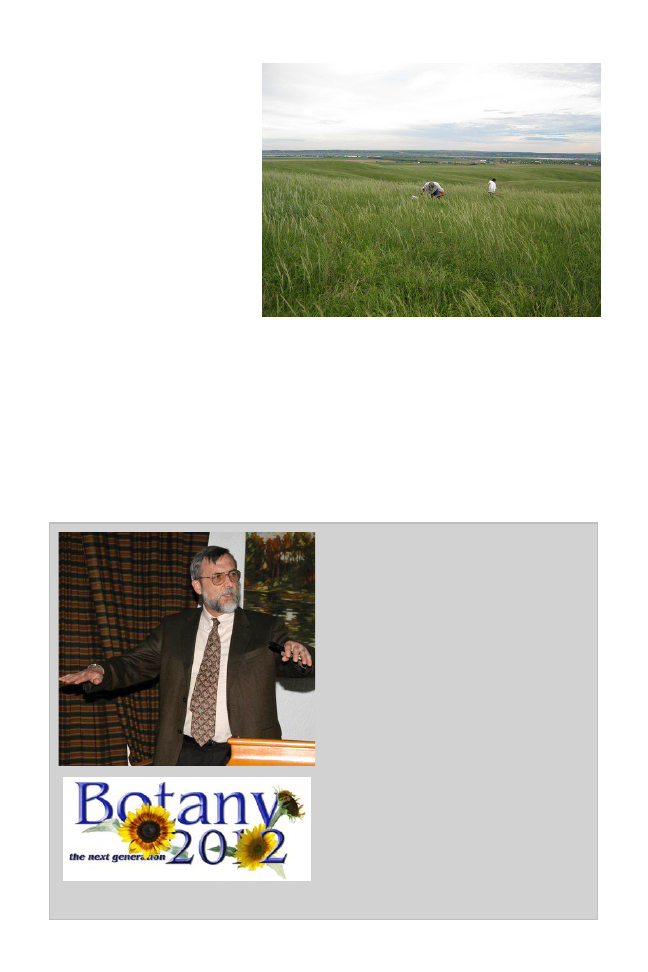
The Crow Creek Indian Reservation was
established in 1862, the result of the exile of the
Dakota People formerly living along the lakes
and rivers of Minnesota in the early 1800s. The
400-square-mile area is located in central South
Dakota bordering the Missouri River, and its
terrain includes prairie bioregion, woodlands,
rivers, Missouri Hills and watershed areas. The
reservation is home to over 2,000 people.
Although several ethnobotanical studies have
been conducted with the Sioux Nation in the
past, no such study has ever been conducted on
the Crow Creek Indian Reservation. William L.
Brown Center (WLBC) staff member Karen Walker
and two students from the local tribal high school
are conducting interviews with members of the
reservation to ascertain their native plant use, both
today and in the past. Project organizers predict
that the diversity of species currently used by
the tribe will be reduced due to ongoing cultural
change, but that some plants native to their vicinity
will be newly recorded.
WLBC staff will invite tribal elders who are
considered knowledge holders in the community to
join them in the field, collecting and vouchering all
useful native plants mentioned during interviews
and documenting the traditional process of plant
collection and harvesting management techniques.
Voucher specimens will be housed at the Missouri
Botanical Garden, with duplicates remaining on the
reservation. Staff will also conduct a floristic survey
of the reservation, emphasizing the presence and
57
Plant Science Bulletin 58(2) 2012
explaining and disseminating information about
the diverse and dynamic relationships between
people and plants throughout the world. Today, 153
years after opening, the Missouri Botanical Garden
is a National Historic Landmark and a center for
science, conservation, education and horticultural
display. With scientists working in 35 countries
on six continents around the globe, the Missouri
Botanical Garden has one of the three largest plant
science programs in the world and a mission “to
discover and share knowledge about plants and
their environment in order to preserve and enrich
life.”
distribution of culturally important
plants.
The resulting information will be
amassed in a database and shared with
the tribe at a native plants workshop
this fall. All members of the tribe will
have access to the voucher specimens
and compiled interview data for
purposes of learning and education.
“It is a great honor and privilege to
work with the Dakota Sioux People,”
said Walker. “As we visit with the elders
and community members, recording
TEK, it reinforces the important role
plants have played in traditional diet,
health and religion. The information
that is being shared with us is a
valuable resource to the whole community. It is
also rewarding to see the excitement and energy
from the students involved—there is no better way
to preserve traditional ecological knowledge than
to have the younger generation learning it directly
from their tribal elders.”
With the William L. Brown Center, the Missouri
Botanical Garden is a global leader in discovering,
The inaugural American Journal of Botany
special lecture at Botany 2012 will feature Gar
Rothwell (Ohio University), who will present
“Integrating Plant Evolution, Paleontology,
and Molecular Genetics: A Developing
Paradigm.”
Rothwell’s talk will focus on how, within
the developmental framework, evolution can
be interpreted as proceeding by the successive
alteration of ontogeny, which is mediated
via regulatory genetics. Neither genetic
sequences nor experimental manipulations
of development are directly available to the
paleontologist. Nevertheless, by identifying
structural “fingerprints” of developmental
regulatory mechanisms, ontogenetic patterns
can be inferred from the morphology and
anatomy of extinct plant species.
For more information on this talk, go to
www.botanyconference.org.
Special Lecture at Botany 2012

58
task, but with many contributors we can deliver
what is needed.”
“The world’s great botanical gardens are proud to
lead this effort,” said Gregory Long, Chief Executive
Officer and The William C. Steere Sr. President
of The New York Botanical Garden. “Thanks to
advances in our botanical knowledge and in digital
technology, an online World Flora is within our
grasp. It is imperative that we create this resource,
which will help us assess the value of all plant
species to humankind and be effective stewards to
ensure their survival.”
“There are few institutions in the world that have
the capacity to foster this project, and no one of us
could do this alone,” added Dr. Peter Wyse Jackson,
President, Missouri Botanical Garden. “We all
want to see this come to fruition, and the entire
international community will benefit from it. With
the botanical resources and knowledge we each
possess, it was implicit that our institutions would
step forward to collaborate on this project.”
Plants are one of Earth’s greatest resources.
They are sources of food, medicines and materials
with vast economic and cultural importance.
They stabilize ecosystems and form the habitats
that sustain the planet’s animal life. They are also
threatened by climate change, environmental factors
and human interaction. There are an estimated
400,000 species of vascular plants on Earth, with
some 10 percent more yet to be discovered. These
plants, both known and unknown may hold
answers to some of the world’s health, social and
economic problems. A full inventory of plant life
is vital if their full potential is to be realized before
many of these species, and the possibilities they
offer, become extinct.
The critical situation for plants, where at least
100,000 plant species are threatened by extinction
worldwide, has been recognized by the U.N.
Convention on Biological Diversity (CBD). In 2002,
a Global Strategy for Plant Conservation (GSPC)
was developed and adopted by the Convention.
In 2004, a Global Partnership for Plant
Conservation (GPPC) was formed, involving
leading environmental, conservation and botanical
organizations who came together to support the
achievement of the GSPC. The four botanical
gardens involved in this new project are all
members of the GPPC.
Announcements
Four Prominent Botanical
Institutions Announce Plans
to Create First Online World
Flora
Missouri Botanical Garden;
The New York Botanical Garden;
Royal Botanic Gardens, Kew; and
Royal Botanic Garden Edinburgh
Leading Effort to Develop World
Flora by 2020
World Flora meeting (ST. LOUIS): The Royal
Botanic Gardens, Kew (RBG Kew), the Royal
Botanic Garden Edinburgh (RBGE), The New
York Botanical Garden (NYBG) and the Missouri
Botanical Garden (MBG), have announced plans to
develop the World Flora—the first modern, online
catalog of the world’s plants—to be made available
by the year 2020. This massive undertaking will
include the compilation of information on up to
400,000 plant species worldwide. It will also achieve
a primary target of the Global Strategy for Plant
Conservation, an ambitious effort first adopted
by the United Nations’ Convention on Biological
Diversity in 2002, to halt the continuing loss of plant
biodiversity around the globe. Representatives of
the four botanical gardens recently met to organize
a framework to guide their efforts and respond to
this need for a baseline survey on the plants of the
world that has been called for by the international
community. A Memorandum of Understanding
(MOU) detailing plans to create the World Flora was
recently signed into effect by the four institutions.
Royal Botanic Gardens, Kew Professor Stephen
Hopper, Director, Royal Botanic Gardens, Kew
said, “Using the wealth of resources available at our
institutions, we will help to provide the baseline
data needed to develop plant-based solutions for
a rapidly changing world. Botanical institutions
worldwide have much expertise to contribute to
this effort to capture the information necessary
to better conserve and sustainably use the planet’s
plant diversity.”
“Botanic gardens have led the way in spearheading
international conservation strategies and programs,
and are a natural partnership for mobilizing much
needed information on plant biodiversity,” said
Professor Stephen Blackmore, Regius Keeper of the
Royal Botanic Garden Edinburgh. “This is a large
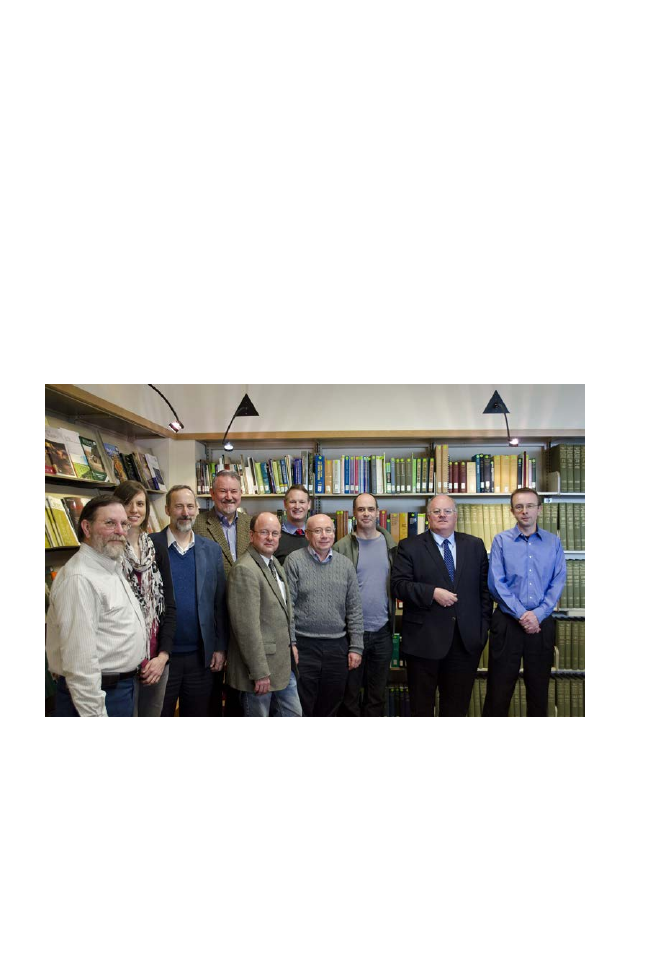
59
Plant Science Bulletin 58(2) 2012
and create a structure and program able to
incorporate data from institutions and individuals
all over the world. In some cases, existing electronic
data sets will be combined and augmented with the
results of botanical research published over more
than a century around the world. Much historic
information will require a thorough review and
update, along with a conversion to an electronic
medium. As new plants are subsequently collected,
named and described, they too will be added to the
World Flora.
“We look forward to working with institutions
worldwide to produce a sustainable resource to aid
conservation globally, regionally and nationally,”
said Hopper.
New York Botanical Garden “An online Flora
of all known plants” is the first of the GSPC’s
targets for the period 2011-2020. Earlier work by
the Royal Botanic Gardens, Kew and the Missouri
Botanical Garden addressed one of the GSPC’s
earlier targets for 2010 with the launch of The
Plant List, an online portal containing the accepted
names and synonyms of all known plant species.
The forthcoming Flora will use The Plant List as a
building block for something much more detailed,
containing not just names but also descriptions,
images and distribution information about every
plant.
The team tackling the World Flora will build a
collaborative partnership for this work worldwide
From L to R: Dr. Bob Magill, Senior Vice President, Science and Conservation, MBG; Melissa
Tulig, Associate Director of the William and Lynda Steere Herbarium, NYBG; Professor Stephen
Blackmore, Regius Keeper, RBGE; Chuck Miller, Vice President, Information Systems, Missouri
Botanical Garden; (front) Dr. James S. Miller, Dean and Vice President for Science, NYBG;
(back) Dr. Mark Watson, Co-ordinator of RBGE’s Major Floras Programme, RBGE; (front) Dr.
David Simpson, Assistant Keeper and Head of Systematics, RBG Kew; Dr. Alan Paton, Assistant
Keeper and Head of Biodiversity, Information and Conventions, RBG Kew; Dr. Peter Wyse
Jackson, President, MBG; Nicholas Turland, Associate Curator, MBG. Photo taken on site at the
Monsanto Center research facility of the Missouri Botanical Garden, January 24, 2012. Photo by
Jeff Ricker, courtesy Missouri Botanical Garden.

60
new species. He amassed a large herbarium
focused on orchids with 64,000 specimens (Sax,
1950). He donated this to Harvard, along with
his economic botany collection and his botanical
library, providing a substantial endowment for its
maintenance. Oakes published scores of articles
and such books as Orchidaceae: Illustrations and
Studies of the Family Orchidaceae (1905), Orchids of
Guatemala (with D.S. Correll, 1952), and Economic
Annuals and Human Cultures (1939). This last was
based on a course he taught in Harvard’s general
education program and stressed the long and
pivotal role of agriculture in human history. The
book became a classic and a major contribution
to the field that Ames helped to found. He also
developed a large economic botany collection
that is still housed at Harvard and that was used
in his teaching. His approach in the classroom
was different from what might be expected in an
economic botany course. His former student Edgar
Anderson (1952) writes that Ames spent little time
on topics like agriculture, but a month on arrow
poisons. Yet somehow he got across the message
that economic botany was an important part of
human history and an intriguing field to explore.
Blanche Ames and Her Many
Interests
Blanche Ames was born in 1878 in Lowell,
Massachusetts. Her father, Adelbert Ames,
was also a Governor, of Mississippi during the
Reconstruction Era after the Civil War. Even
though Oakes and Blanche shared a surname, they
were not related. A graduate of Smith College, she
married Oakes in 1900. They had four children,
and early in their marriage they lived with Oakes’s
mother, in an admittedly spacious house, but under
less than ideal conditions. While Oakes was on a
trip to Europe in 1905 doing research on orchids,
Blanche went house hunting, reporting to Oakes
by letter on a lovely home she was considering.
Oakes wrote back telling her not to be too hasty,
but upon his return, he got the message clearly
enough that they bought property in North Easton
with a farmhouse where they lived for several years
until Borderland was built. Oakes’s mother wasn’t
happy about the move and threatened to prevent
him from taking his orchids, though she eventually
relented after an exchange of tense letters.
Blanche Ames is one example among many of
wives who supported their husband’s botanical
work artistically. Marion Ruff Sheehan documented
Blanche and Oakes Ames: A Rela-
tionship of Art and Science
Maura C. Flannery
Professor of Biology
St. John’s University, Bent 268
Jamaica, NY 11439
Submitted 15 October 2011
Accepted 8 March 2012
Blanche and Oakes Ames are a fascinating
couple, as is evident in Jottings of a Harvard
Botanist (1979), a collection of Oakes Ames’s
writings, from letters to speeches to diary entries.
All these deal with his life as a Harvard botanist and
his relationship with his wife, Blanche. Almost 30
years after his death in 1950, his daughter Pauline
Plimpton assembled these materials, and her son
George Plimpton wrote the Foreword. Particularly
interesting from the viewpoint of their relationship
are the letters that Ames wrote to Blanche, as
well as the stories about their home, Borderland,
which she designed to include a two-story library,
a laboratory, and a herbarium for Oakes to use for
his orchid research. Blanche was an accomplished
artist who did hundreds of illustrations for her
husband’s botanical publications. Several of her
drawings are included in Jottings as is her portrait
of Oakes. There are also the details of her many
other endeavors, ranging from politics to invention.
Oakes Ames was born in 1874 in Easton,
Massachusetts to a family that had made its
money producing shovels—for the Pacific Union
Railroad. They had a greenhouse on their property,
and Oakes’s father, Oliver Ames, who had been
Governor of Massachusetts, grew orchids among
other plants. It was the orchids that attracted
Oakes. From an early age, he grew his own orchids
and developed an extensive collection, which he
donated to the New York Botanical Garden in
1906, relatively early in his career. Thereafter he
relied primarily on herbarium specimens for his
research. He attended Harvard University and
went on to spend his entire working life there,
becoming professor of botany, chair of the botany
department, and director of the Botanic Museum
and the Arnold Arboretum.
Oakes participated in collecting expeditions to
Central and South America, Florida, the Philippines,
and the Caribbean, naming over a thousand
Reports and Reviews

61
Plant Science Bulletin 58(2) 2012
the work of his husband Thomas Sheehan, also
an orchid expert; Joseph Hooker’s wife, Maria,
did engravings for his publications; and both the
wife and eldest daughter of the agronomist and
botanist Lewis Sturtevant created illustrations for
his writings. While some women’s contributions
were hidden by the fact that their works were
unsigned, Blanche signed everything she produced.
In addition to doing illustrations for Oakes, she
also did them for his colleague Donovan Correll’s
Orchids of North America North of Mexico (1950).
It is evident in many ways that Blanche did not
sit quietly drawing orchids. She managed a family
of four children with several homes and had time to
seriously support causes from women’s suffrage to
birth control, including creating a series of cartoons
for the suffragist cause (Clark, 2001). Since both her
parents had been inventors, Blanche saw design as
a normal response to practical dilemmas. When
the architect who was designing their house proved
impossible to work with, she undertook the task
and worked with contractors. She also devised
the drainage system for the property—with dams,
and time has proven its practicality. During World
War II, she patented an apparatus to trap enemy
planes, and when 90 years old, she developed an
antipollution device for toilets (Crane & Haff, 1982).
Blanche obviously didn’t see age as a barrier. When
in her eighties, she wrote a biography of her father,
Adelbert Ames (Ames, 1964). She undertook this
project in response to John F. Kennedy’s (1956)
Profiles in Courage where Adelbert was labeled as a
carpetbagger governor of Mississippi.
With another family member, her brother
Adelbert (Del) Ames II, Blanche developed a series
of color charts, with about 3300 color variations,
making it more comprehensive than the Musell
Color System. It took them over a year to create
the entire scheme, and Blanche employed it in her
paintings to illustrate its usefulness. This work
led them to an investigation of perception, and
in particular of binocular vision (Behrens, 1998).
Their collaboration yielded a device to replicate
binocular vision, and Blanche painted several still
lifes to test it out. Del published three papers on
their work, two with co-author Charles Proctor,
but Blanche was not included as a co-author on
any of these. When he showed her the draft of a
fourth paper, she rebelled; they had heated words
during which Del claimed that she had contributed
nothing to his ideas. This resulted in several
letters between the two that eventually calmed the
situation. Blanche became co-author on the paper,
but the siblings never collaborated again (Ames,
Proctor & Ames, 1923).
Throughout their marriage, while serving as
Ames’s chief illustrator, Blanche also painted
portraits and a number of commissioned pieces,
including a mural (Orchids and Artists, 1991). She
worked in several different media from watercolor
to oils to etchings to relief sculptures, as well as in
pen and ink—the staple of botanical illustrators.
There are many examples of two types of her work
at the Oakes Ames Herbarium at Harvard. First are
her pen and ink drawings that are frequently found
on the herbarium sheets, sometimes as copies,
documenting the drawings she did for Oakes’s
publications.
Secondly, there are a number of her watercolors
that are also included on herbarium sheets. Some
were done while she and Oakes were visiting
herbaria including the Botanical Museum Berlin-
Dahlem in 1922. One of these is a watercolor
of Stanhopea ruckeri Lindl. This was based on
a flower that the botanist and orchid authority
Rudolf Schlecter had been carrying as a means
of identification when he met them at the Berlin
railroad station on the evening of August 25.
Blanche lost no time getting to work. She did
a number of watercolors of individual species
over the next few days—several a day—including
Stanhopea. On the herbarium sheets at Harvard,
there are not only the watercolors, each dated, but
cuttings taken from the Berlin collection that were
used as models for Blanche’s art and then pressed by
Ames. These sheets are now particularly significant
because almost all the specimens in Dahlem where
destroyed in a bombing raid in 1943 (Angell &
Romero, 2011).
Oakes Ames was obviously not a purist who
thought that only specimens should be put on
herbarium sheets. He included photographs of
live plants and of herbarium specimens from
collections he’d visited, as well as Blanche’s
drawings and some of his own, which are simpler
and rougher. Frequently a copy of one of Blanche’s
published drawings with her exquisite lettering
is included; sometimes there is a portion of a
published article or even on the entire article pasted
to a sheet. There are also sketches by others such
as Charles Schweinfurth, a botanist who worked
with Ames for 35 years. The sheets sometimes
look rather cluttered, but they are obviously rich
sources of information and are indicative of Oakes’s
philosophy that an herbarium sheet was a working
document.
The Charts
Among the most impressive illustrations that
Blanche created are the “Ames Charts” done in
1916 and 1917 for Oakes’s economic botany course.
They are kept in the archives of the Harvard Botany
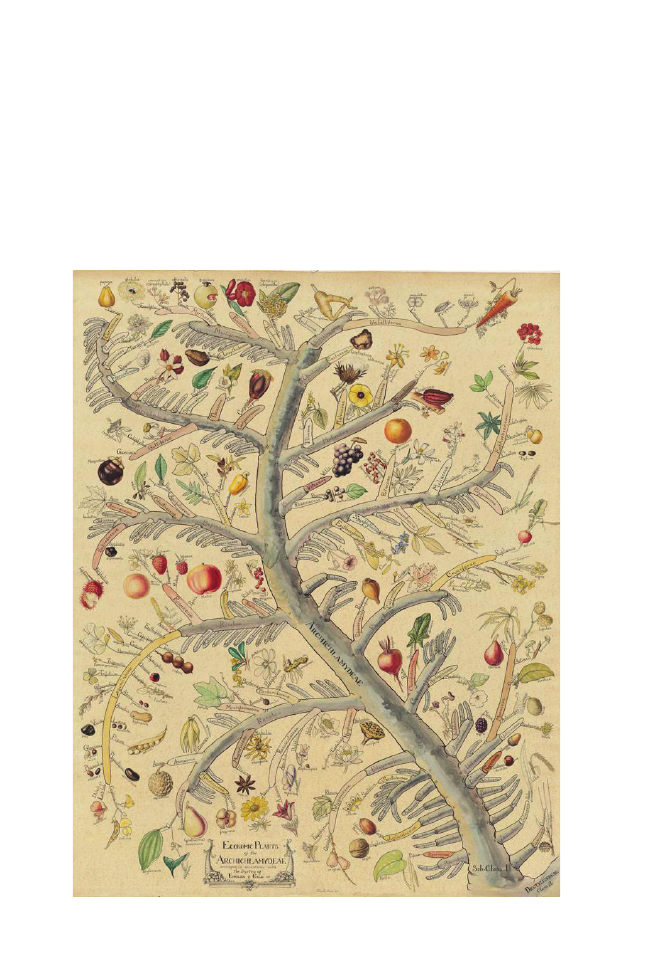
62
Plant Science Bulletin 58(2) 2012
Libraries and are very well-preserved. They were
hanging in the Nash Lecture Hall, the economic
botany classroom, until it was dismantled in the
late 1980s. They had been framed under glass,
which explains their excellent state of preservation,
as does the fact that Blanche obviously used the best
paints.
These are amazing works, varying in size but
approximately three by four feet. They are India ink
with watercolor renderings of phylogenetic trees
showing the relationships among species of useful
plants. The largest has the title, “Economic Plants
of the Archichlamydeae arranged in accordance
with the System of Engler & Gilg.,” presented in a
decorative calligraphed label at the bottom of the
chart, reminiscent of labels on old maps (Figure
1). The label includes the title, bordered on either
side with a cornucopia and a vase of flowers at
the bottom center; there is also a tiny peanut after
“Gilg.” This small touch suggests that Blanche had
fun on this project and that she enjoyed working
with Oakes. The base of the tree is marked
“Sub-Class 1,” with the stump of another trunk,
“Dicotyledoneae Class 2,” pushing out to the side;
Figure 1. Economic Plants of the Archichlamydeae arranged in accordance with the System of Engler & Gilg.

63
Plant Science Bulletin 58(2) 2012
the latter is presented in a separate chart. The major
trunk is labeled Archichlamydeae with several
branches and sub-branches also labeled. There
are 30 branches, numbered 1 at the bottom to 30
at the top. The branches are of varying thicknesses
representing higher taxa; a genus name is noted by
an ink line extending to a drawing with the species
name alongside the drawing.
On the tree there are dozens of sketches of plants,
fruits, nuts, representing species of economic
importance. The entire chart is covered with these
small watercolor drawings of plants; some of the
pencil marks from underlying sketches remain.
The arrangement of the drawings on the tree is
extraordinary. It must have taken Blanche a long
time, and many preliminary sketches, to develop
the layout. This is truly a labor of love as well as a
masterpiece of scientific illustration. I can imagine
Blanche and Oakes putting their heads together
over the sketches, she blocking out individual
branches, and he making changes, suggesting which
plants he would like to use as examples. When it
was completed, she signed it “Blanche Ames 1916.”
The chart titled “Economic Plants of the
Metachlamydeae arranged according to the system
of Engler & Prantl” is the companion to the first.
This has the best of the labels, rivaling that of a fine
Renaissance map. On one side of the label’s text
there is an ink drawing of a woman representing
Ceres, goddess of agriculture, and on the other a
Native American surrounded by baskets, smoking
pipe, corn, etc. This chart is not as large or elaborate
as the other, but it still fills the page. The base of the
trunk is labeled “Class 2 Dicotyledoneae.” Going up
the trunk is the label: “Subclass 2 Metachlamydeae
or Sympetalae.” There are no numbers on the
branches here as there are on the other chart, but
branches are labeled “order” at the point where each
attaches to the trunk. The chart is again signed
“Blanche Ames 1916” and her humor, or his, again
shows itself, this time in a drawing of Ecballium
elaterium, the squirting cucumber, in the process
of squirting.
The patience and the detail found in the
drawings—all the tiny hairs and the stippling—are
exceptional. In addition to ink and watercolor,
Blanche used graphite for very subtle shading in
places, so she really wanted to get it right. There
is still greater detail in the chart labeled “Genera
of the Gymnospermae with the more important
Economic Species arranged after Engler & Gilg.
modified.” It is an amazing production; there is
much more work here because of the pinecones.
There is also more detailing on the branches to
highlight all the texture. This sheet is signed
“Blanche Ames, 1917,” so it must have been
completed in the year following the other charts.
There was obviously a limit to what even she could
accomplish in a year.
Other Work
Blanche did a different type of art for another
of her joint enterprises with Oakes, the Christmas
cards they sent from 1937 to 1949. Each year’s card
included an etching by Blanche of an orchid—of
course—as well as a poem or other quote from
writers such as Wordsworth, Whitman, and
Robert Browning, which were chosen by Oakes.
The etchings often had imaginative backgrounds,
such as the interior of a cathedral. All these cards
were reprinted in a small book called Orchids at
Christmas originally published in 1975 and then
reprinted in 2007 with additional commentaries.
It is a lovely little book and indicates that even
though more than a generation had passed since his
death, Oakes was still admired and remembered at
Harvard, as was Blanche.
In 1947, Blanche and Oakes jointly published
Drawings of Florida Orchids, with Blanche as first
author. As usual, she supplied the illustrations
and Oakes the text of short descriptions of the
orchids pictured. Whereas in his scientific works
the illustrations complement the text, here the
illustrations take center stage as they were intended.
The two came up with the idea for this publication
in late 1946, in preparation for a talk that Blanche
was planning to present to the Garden Club of the
Halifax Country in Ormond Beach, Florida where
they spent winters after Oakes retired from Harvard
in 1941. In a matter of months, they had completed
the manuscript, and it was published by the press at
the Botanical Museum of Harvard University, which
Oakes had founded. The illustrations include some
that Blanche did specifically for this book, but also
a selection of works from their lifetime together
studying orchids. It is a lovely monument to their
accomplishments.
Blanche also did an number of sculptural reliefs
of botanical interest. One was the official seal of
the American Orchid Society, which she and Oakes
helped to found in 1921 (Crane & Haff, 1982). The
seal depicts an American Indian kneeling down
to look at an orchid plant. She also created a seal
that Oakes Ames used in publications of Botanical
Museum of Harvard Press. Perhaps her most

64
Plant Science Bulletin 58(2) 2012
ambitious sculptural work was the monument she
designed as a gravestone in the months after Oakes
died of heart failure in 1950. She sculpted it in clay,
then had it cast in plaster and finally in bronze.
It is set above her grave and that of Oakes in the
Unity Cemetery in North Easton, Massachusetts.
Of course, it is decorated with orchids, including
tropical species as well as lady’s slipper orchids
native to the Northeast. It’s easy to imagine that
creating this masterpiece was a way for Blanche to
continue her 50-year relationship with her husband
and his work.
Finally, an oil still life that Blanche painted
deserves mention. It relates to the other types of art
she produced. It includes—along with the requisite
orchids—a microscope, a magnifying glass, and a
flask that appears to contain an orchid specimen
preserved in alcohol. Many of the drawings Blanche
did of the reproductive parts of orchids were based
on such specimens; Oakes had thousands of them.
I like to think that this painting is an idealized
view of the materials Blanche used in creating her
artwork for Oakes. The book in the painting might
be a reference on orchids, perhaps written by Oakes
himself. The entire orchid as well as its dissected
parts are at hand; the microscope and hand lens are
there for getting the details right. When they were
courting, Oakes presented Blanche with the gift of
a microscope—what a romantic devil. Perhaps it is
this very microscope that’s pictured in the painting.
Note: I would like to thank Lisa DeCesare,
Irina Ferraras, Gustavo Romero, and Judith
Warnement for their gracious assistance at
the Harvard University Herbaria and Botany
Libraries, as well as the reviewers for their
useful comments. This article was written with
the support of the St. John’s University Faculty
Writing Initiative.
References
Ames, A., Proctor, C. A., & Ames, B. 1923. Vision
and the technique of art. Daedalus 58: 3-47.
Ames, B. 1947. Drawings of Florida orchids.
Botanical Museum of Harvard University,
Cambridge, Massachusetts, USA.
Ames, B. 1964. Adelbert Ames, 1835-1933: General,
Senator, Governor. Argosy-Antiquarian, New
York, New York, USA.
Ames, O. 1905. Orchidaceae: Illustrations and
studies of the family Orchidaceae. Houghton,
Mifflin, Boston, Massachusetts, USA.
Ames, O. 1939. Economic annuals and human
cultures. Botanical Museum of Harvard
University, Cambridge, Massachusetts, USA.
Ames, O. 1979. Jottings of a Harvard botanist.
Botanical Museum of Harvard University,
Cambridge, Massachusetts, USA.
Ames, O., & Ames, B. 2007. Orchids at Christmas
(Reprint edition). Botanical Museum of
Harvard University, Cambridge, Massachusetts,
USA.
Ames, O., & Correll, D. S. 1952. Orchids of
Guatemala. Chicago Natural History Museum,
Chicago, Illinois, USA.
Anderson, E. 1952. Plants, man and life. University
of California Press, Berkeley, California, USA.
Angell, B., & Romero, G. A. 2011. Orchid
illustrations at Harvard. The Botanical Illustrator
17: 20-21.
Behrens, R. 1998. The artistic and scientific
collaboration of Blanche Ames Ames and
Adelbert Ames II. Leonardo, 31: 47-54.
Clark, A. B. 2001. My Dear Mrs. Ames: A study
of suffragist cartoonist Blanche Ames Ames. P.
Lang, New York, New York, USA.
Correll, D. S. 1950. Native orchids of North
America north of Mexico. Chronica Botanica,
Waltham, Massachusetts, USA.
Crane, B. L., & Haff, E. C. 1982. Blanche Ames:
Artist and activist (1878-1969). Brockton
Art Museum/Fuller Memorial, Brockton,
Massachusetts, USA.
Kennedy, J. F. 1956. Profiles in courage. Harper,
New York, New York, USA.
Orchids and Artists: Five centuries of botanical
illustrations from Peter Schoeffer to Blanche
Ames ’99. 1991. Smith College Museum of Art,
Northampton, Massachusetts, USA.
Sax, K. 1950. Oakes Ames, 1874-1950. Journal of
the Arnold Arboretum 31: 335-349.

65
Book Reviews
Developmental and Structural
The Shaping of Life: The Genera-
tion of Biological Pattern
Lionel G. Harrison
2011. ISBN-13: 978-0-521-55350-6
Cloth, US$99.00. 247 pp.
Cambridge University Press, New York, New
York, USA
When it comes to life on our planet, humans
have made significant progress in exploring
what and where, more or less distilling when,
ever busying ourselves with whom and why. In
The Shaping of Life: The Generation of Biological
Pattern, Lionel G. Harrison delivers a compelling
look at how. Growth is a tremendous and complex
realm of study, and here Harrison reaches beneath
the more common analysis of structures and their
functions to uncover the processes responsible for
the living forms that exist. In a rich combination
of theory, experimentation, mathematics, and
metaphor, Harrison expands his first book, Kinetic
Theory of Living Pattern (1993) with his own work
and further research, compiling into one volume
the questions, philosophy, and methodology of
physical chemistry in the quest for understanding
how chemistry and physics on the microscopic level
develop into the biological life we recognize.
Harrison is methodical and thorough in his
approach. In each of the three parts, a brief and
primary exposition addresses the fundamental
theories of the subject, the conflicts therein, and the
possible paths of study. The explication that follows
each includes his own experiments and the models,
images, and differential equations derived thereof.
Throughout his work there is frequent reference
to a number of scientists, from Aristotle in his
Generation of Animals to Harrison’s own student M.
J. Lyons and his work with stripe selection in pattern-
forming models with linear systems and electron
microscope imaging (1992). Harrison’s background
in physical chemistry is pronounced, but in his
integration of metaphors from the operatic works
of Offenbach to the elementary truths of Isaac
Newton, he demonstrates a broad appreciation for
creative inquiry. The organization is clear, from the
concise table of contents to the expansive library of
resources in which he consistently draws specific
and pertinent references.
The heart of Harrison’s investigations is the
movement within and between that which creates
organization and that which is organized. In his
first pages he asserts, “I am concerned mainly
with how the tiny, partly fragmentary and partly
one-dimensionally ordered genetic beginnings are
transformed into the three-dimensional organism
by the processes of development.” From there,
he delves into the dynamics of the chemical and
Books Reviewed
Developmental and Structural
The Shaping of Life: The Generation of Biological Pattern ............................................65
Ecological
Fire in the Forest ..............................................................................................................67
The Last Great Plant Hunt: The Story of Kew’s Millennium Seed Bank .......................68
Mycological
21st Century Guidebook to Fungi ....................................................................................69
Paleobotanical
Early Flowers and Angiosperm Evolution ......................................................................70
Physiological
Light and Photosynthesis in Aquatic Ecosystems ...........................................................73
Systematics
Hardy Heathers from the Northern Hemisphere:
Calluna, Daboecia, Erica ..............................
74

66
Plant Science Bulletin 58(2) 2012
physical reactions in a number of growths in minute
detail. Plants are his first subjects, in which he
dissects the nature of cell division and anisotropic
changes of shape. Much of his research focused on
Acetabularia acetabulum, a lengthy aquatic plant
(at 4 cm) with a single nucleus, whose propensity
for developing vegetative whorls elucidated the
possibility for reaction–diffusion mechanisms
as a source of such development, rather than the
“mechanical buckling” that is favored by some
scientists. The more complex nature of higher
order plants was studied in the same vein with
somatic embryos of conifers, whose generation in
vitro allowed visibility in another level of vegetal
complexity. Within this venture, Harrison sought
a “natural continuity” between unicellular and
multicellular plants. His studies complemented the
work of P.B. Green et al. (1996) and their work in
phyllotactic patterns to develop the proportions
and interactions between the aforementioned
reaction–diffusion process and mechanical
buckling. Studies of the latter involved the genus
Microasteras, another aquatic marvel in the desmid
family of algae that is renowned for its repeated
dichotomous branching.
In its second part, the text explores the likenesses
in development mechanisms in plants and
animals, once again questing for interdisciplinary
compatibility. There is a powerful merger here
of two of the other pioneers in the field, V. B.
Wigglesworth (1940) and A. M. Turing (1952),
where Harrison synthesizes their theories of
activation–inhibition dynamics with extensive
detail into diffusion-driven stability and how
patterns of chemical concentration yield harmonic
waveforms.
There is much attention throughout the book
to the classification of processes and then their
integration. His three largest considerations from
an aspect of physical chemistry are structure,
equilibrium, and kinetics. Within this framework,
he develops his own “pseudo phyla” of reaction–
diffusion, mechochemical, self-electrophoretic, and
complex intercellular systems. As he moves into the
animal kingdom, he continues with these features
on the microscopic level, first with the attractive
forces that distribute cells into layered spheres
and later to the expression of stripes and spots,
onward until the paraxial mesoderm of the axolotl
(amphibian) during somite formation. He makes
clear the two singularly animal behaviors of having
precise placement of specific cell types that produce
a function and the movement of cells during
development. The final chapter on gastrulation is
not of his research, but an assembly of information
about the body plans of most metazoa that
cumulates the similarities in the kingdoms Plant
and Animal, almost apologizing for the fact that
he was unable to understand or explore all of each
territory.
This book is by no means intended for the faint
of heart. While its title might provoke thoughts of
the wholesome passage of pupae to butterfly, its
pages reveal the seemingly infinite complexity of
physical chemistry and formation biology. While
he does present a thorough introduction to each
investigative tool in his arsenal, the differential
equations and intricacy of mathematical models
can be a steep climb. Broad theory of scientific
disciplines intermingles with uncommonly exact
investigation, and it is really the responsibility of
the reader to ponder that middle ground in his or
her own applications. To those specifically seeking
evidence and methods of inquiry into cell sorting
and pattern forming of “simple” plants, hyphae,
embryonic development, and the dynamic theories
therein, The Shaping of Life is an excellent resource.
To those with interest in the evolution and theory
at the interface of physical chemistry and the
biological sphere, this book offers a pithy and well-
informed perspective. For those who hope for
beautiful pictures, it would be best to put down the
book and go outside.
Harrison does not give answers or paint pictures,
but his clarity of thought and his holistic approach
to education are intended to inspire others in
the pursuit of understanding. Indeed it has, for
when Lionel Harrison passed in 2008 his book
was unfinished; it was his team of colleagues and
students who shaped and delivered his work to
the world. Harrison’s distinctive writing style
is evident in his sharp wit and fervent love of
physical chemistry, but it is Harrison’s desire for
collaboration and integration that really makes his
final work appropriately the work of many.
LITERATURE CITED
GREEN, P. B., C. R. STEELE, and S. C. RENNICH.
1996. Phyllotactic patterns: A biophysical
mechanism for their origin. Annals of Botany
77: 515–527.

67
Plant Science Bulletin 58(2) 2012
HARRISON, L. G. 1993. Kinetic Theory of
Living Pattern. Cambridge University Press,
Cambridge, United Kingdom.
LYONS, M. J., and L. C. HARRISON. 1992. Stripe
selection: An intrinsic property of some pattern-
forming models with nonlinear dynamics.
Developmental Dynamics 195: 201–215.
TURING, A. M. 1952. The chemical basis of
morphogenesis. Philosophical Transactions of
the Royal Society of London, Series B, Biological
Sciences 237: 37–72.
WIGGLESWORTH, V. B. 1940. Local and general
factors in the development of “pattern” in
Rhodnius prolixus (Hemiptera). Journal of
Experimental Biology 17: 180–200.
–Rebecca Bender, Department of Civil Engineer-
ing, Michigan Technological University, Houghton,
Michigan, USA
Ecological
Fire in the Forest
Peter Thomas and Robert McAlpine
2010. ISBN-13: 978-0-521-82229-9
Hardcover, US$49.00. 225 pp.
Cambridge University Press, New York, New
York, USA
Fire in the Forest is an interesting international
introduction to the intriguing and sometimes
enigmatic role that fire plays in natural and
increasingly human-inhabited ecosystems. It is
presented from a nontechnical, but well-referenced,
point of view by the two primary authors, who are
well positioned to provide such insights on this topic.
The text is divided into a logical progression of
subjects beginning with an examination of the
occurrence of fire in both geologic and historical
landscapes throughout the world. Next, the physics
of fire is examined in general terms, and these
factors are placed within the context of various
forests within American, Eurasian, and Australian
landscapes. Impacts on abiotic and biotic
components of ecosystems subject to periodic
fire are then explored. A guest chapter by Peter
Hobson examines the benefits and challenges of
using fire as a landscape management tool within
our contemporary society, in which the wild
land–urban interface continues to expand. An
informative look at current methods of monitoring
and making decisions to let burn or suppress
wildfires is provided, and the different methods and
approaches that are utilized on various continents
are compared. The book concludes with a guest
chapter by Kelvin Hirsch, director of the Climate
Change and Forests Research Program of the
Canadian Forest Service, who examines via three
case studies, and some hypothetical scenarios,
the potential ways that we may learn to live with
and eventually utilize fire within our increasingly
human-dominated natural forested environments.
For those readers who are inspired to pursue this
subject from a more intense research-oriented
perspective, the book provides a list of more
in-depth treatises on the role of fire in various
ecosystems throughout the world. Each chapter
includes judiciously placed references, so that
readers seeking a more in-depth account of various
subjects can pursue these at will. The frequency of
these citations is appropriately spaced so that the
text reads more like an informative nonfictional
account than a research-oriented textbook. The
color illustrations serve to clarify or illustrate
the main points being made by the authors in an
effective manner. The boxed tables and highlighted
detailed studies blend well with the themes of each
chapter. The text is well indexed, although why
most scientific binomials reference a common
name, rather than a page number, escapes this
reviewer. In short, it is a well-constructed book that
will engage the reader at multiple levels.
In summary, this book does an excellent job of
attaining its stated objective of providing the reader
with a nontechnical introduction to the mechanics
of fire and the role that fire has played and will
continue to play in various forest ecosystems
throughout the world. This reviewer found the
international perspective especially informative,
and the authors do an excellent job of making the
reader aware that management of fires throughout
the world’s forests is and will remain an important
management challenge for the foreseeable future.
The text provides sufficient references so that
readers who are stimulated to pursue this topic
on a more detailed research level are provided
with handy entry-level citations. It is highly
recommended for the shelves of every well-stocked
educational library, especially those facilities that
are frequented by high school and undergraduate
students interested in entering environmental and
ecosystem management–related professions.
–Roger D. Meicenheimer, Department of Botany,
Miami University, Oxford, Ohio, USA

68
Plant Science Bulletin 58(2) 2012
The Last Great Plant Hunt: The
Story of Kew’s Millennium Seed
Bank
Carolyn Fry, Sue Seddon, and Gail Vines
2011 ISBN-13: 978-1-84246-432-8
Cloth, US$45.00. 192 pp.
Kew Publishing, Royal Botanic Gardens,
Kew, Richmond, Surrey, United Kingdom
The Millennium Seed Bank at the Royal
Botanic Gardens, Kew, is the world’s largest plant
conservation program. This book, published by
the Royal Botanic Gardens, commemorates the
Millennium Seed Bank Project (MSBP), a 10-year
effort completed in 2010, and the Millennium Seed
Bank Partnership (confusingly, also referred to
as MSBP), an ongoing global project to catalogue
seeds from plants threatened by extinction (the
official goal is to gather seeds from 25% of global
plant species by 2020). The book is written well,
but organized clumsily, and the bureaucratic
spirit that seems to accompany the altruistic
efforts of nongovernmental organizations—such
as the Royal Botanic Gardens—permeates this
book. It is an unusual work, at times seeming
like a government report, replete with statistics
indicating past courses of action, at other times
sounding like a school textbook or museum
display, explaining a particular “plant hunt”
through maps, panoramic photographs, and
interviews with affected locals. The book doesn’t
rely on a straightforward, A-to-Z description of
what the Millennium Seed Bank Project and/or
Partnership are; instead, it is a loose collection of
related short essays connected by the common
theme of the MSBP. Interspersed throughout these
essays are accompanying photographs, some of
which are incredibly beautiful. The reader has to do
quite a bit of work assembling the diverse tidbits of
information describing the MSBP and integrating
them into a unified account of what exactly the
program is about. On the other hand, the diversity
of subprojects involved is staggering, and perhaps
a single account would have related this fact less
effectively.
The Last Great Plant Hunt tells the reader two
stories: firstly, it impresses upon the reader the
importance of plant biodiversity; and secondly,
it explains how seed banking, along with other
conservation efforts, can act as a bulwark against
extinction. Ostensibly, the book is divided into six
sections: what the “last plant hunt” is; the global
scale of the MSBP; a series of semi-independent
accounts of how seeds are recovered from
environments across the world; a primer on how
seed banking works; what kinds of applications are
possible using banked seeds; and how to begin to
restore “degraded ecosystems” using seeds. In actual
fact, these sections are broken up with numerous
short features and full-page photographs.
One of the interesting parts of this book are the
“Job Profile” features describing the role of specific
workers at the MSBP. For example, International
Coordinator Michael Way is introduced to the
reader as a botanist working with scientists in Chile
to help bank seeds from endangered local flora;
a short background on his work is accompanied
by some of the best photographs in the book.
Laboratory and Building Manager Keith Manger
is introduced as a senior leader at the Seed Bank.
Seed Germination Specialist Rosemary Newton
is presented as the MSBP’s resident germination
problem solver, identifying ideal germination
conditions for some of the seed bank’s tough
cases. Some of the one-page descriptions of MSBP
employees are interesting and some aren’t, but the
intention seems to have been to put a human face
on the conservation efforts of the seed bank, and
with respect to this goal, the profiles are successful.
Perhaps more interesting to the average botanist
are the descriptions of the seed banking processes
themselves. There is a short description of the
seed vault (“The Most Biodiverse Building on
Earth”), the storage procedures, the research being
performed on seed germination, and many other
topics relating to the science of banking seeds.
These sections are definitely the high points of
the book. Although a good portion of the book is
devoted to this topic, the tour seems a little short
on detail, and the reader may be left wanting more.
Accompanying nearly every section of this book
are photos. Pictures of seeds, of plants, of scientific
equipment, of the MSBP personnel, of the Wellcome
Trust Millennium Building, of landscapes—all are
present in abundance, as The Last Great Plant Hunt
contains over 150 color photographs. These photos
are the other main strength of this book—many of
the pictures are eye-catching and beautiful. It isn’t
just that the photographers only snapped shots of
strange and unique plants either, although there are
some of these, including a great two-page spread of
traveller’s palm (Ravenala madagascariensis) seeds
wrapped in bright blue casings—some of the best
shots are of relatively common species.

69
Plant Science Bulletin 58(2) 2012
for understanding growth and development of
fungi. The operating manual is very detailed with
excellent instructions. The user can install the
program or directly start the application and work
with it using the IE browser. Everything is designed
to be either downloaded or used directly from the
browser, and is very user friendly. The Neighbour-
Sensing applet is computationally demanding, so
it is important to have a reliable computer with
good speed. The CD is a great feature of the book,
making this an outstanding resource.
The book starts with an overview of fungal
communities and microbial diversity, including
the importance of fungi in agriculture. A table
describing the roles and activities of fungi in
biogeochemical processes serves as the appetizer
for what is yet to come. The diagrams included
are nicely done, and the photomicrographs are of
excellent quality. The description of evolutionary
origins in Chapter 2 is delightful. The authors
manage to put together the “big picture,” including
a history of the universe from its formation and
the developmental changes that resulted in the
formation of Earth and the origin of the Earth–
binary system, creating the perfect conditions for
life. It was a very enjoyable chapter to read, showing
fungi in the context of the universe, something that
few books are able to address. The authors include
tables with additional terminology to allow readers
to grasp the material better.
The description of the members of the Kingdom
Fungi is nicely done. The authors include
information about mechanisms such as sirenin that
allow male gametes to find the female gametes. The
writing familiarizes the reader with the intricacies
of the world of fungi and allows experts to keep this
book as a reference. The writing is appropriate for
both students and experts; it will be an excellent
textbook for teaching because it introduces the
concepts with great narration and points of interest
about the world of fungi. The life cycles of the
fungi are described clearly for the novice and the
expert. The photomicrographs are of superb quality
and serve as a great source of information for the
identification of diagnostic characteristics in fungi.
Several of the most important photographs are
provided in both black and white and color (after
pages 149 and 340); perhaps it would have been
better to see those color pictures the first time they
were shown, but reduction of costs sometimes
requires doing things like this.
All in all, this is a strange book. It isn’t really a
coffee table book, despite its size and being stuffed
with gorgeous pictures, since it consists largely
of essays. The book has no real introduction,
where the authors typically describe the purpose
of the book; bizarrely, the closest that any part
of the book comes to an overview is the short
foreword from HRH Prince Charles, the Prince
of Wales, in which he outlines what he thinks the
book is about. Furthermore, this book appears to
have been ghostwritten by the authors working
alongside scientists and bureaucrats at the MSBP,
and at times sounds more like an advertisement
than an in-depth look at what the Millennium Seed
Bank Partnership is all about. That being said, the
book is interesting even when the material isn’t,
and manages to get the reader inspired about seed
banking, which may not, even among botanists, be
the sexiest topic imaginable. Although unsuitable
for a serious, in-depth academic study and at times
somewhat confused in terms of its organization,
this book is an exciting and visually appealing look
at the purpose and practice of seed banking, a vital
practice in modern plant conservation biology.
–P. William Hughes, Biology Department, Carleton
University, Ottawa, Ontario, Canada
Mycological
21st Century Guidebook to Fungi
David Moore, Geoffrey D. Robson, and An-
thony P. J. Trinci
2011. ISBN-13: 978-0-521-18695-7
Paperback, US$65.00. 626 pp.
Cambridge University Press, New York, New
York, USA
This book originated from many years of
the authors’ teaching experience. It is a written
in delightful prose, integrating concepts and
interdisciplinary knowledge. When a particular
topic is not covered extensively, the authors direct
the readers to additional literature. This facilitates
its use as a textbook in the classroom and as an
independent learning tool. The book comes with
CD that, when started, opens in Internet Explorer.
The CD contains a hyperlinked version of the entire
book, the integrated World of Cyberfungi website,
and a great growth simulator program called the
Neighbour-Sensing program. Tropisms models
included are outstanding sources for learning and

70
Plant Science Bulletin 58(2) 2012
The description of the kinetics of colony
formation and hyphal branching is clear and
concise. If the book is used in the classroom, it
will help students understand how these kinetic
analyses are done, allowing students to design
their own experiments if inquiry-based exercises
form part of the coursework. The authors provide
resources such as virtual cell animations in shaded
boxes that are useful for both teachers and students.
One full chapter is dedicated to the fungal cell wall,
which is useful given this structure’s wide range
of functions. In addition, the authors address the
“far side” of the cell wall with a discussion of the
presence of mating proteins (agglutinins), cell
adhesion proteins (adhesins), hydrophobins, and
glomalins. Furthermore, the authors discuss the
fungal cell wall as a target for chemotherapy, a topic
they address in more detail in Chapter 18.
Fungal genetics and diversity are nicely
discussed and the concepts are illustrated with
clear diagrams that are easily understood by both
novices and experts. The sexual reproduction
chapter describes mating systems and provides
examples in Saccharomyces, Neurospora,
Basidiomycota, among others; however, the list
of references from this section (8.7) could benefit
from more recent publications. The section on
biochemistry and developmental biology of fungi
includes a discussion of the contribution of fungi to
ecosystems leading to the biochemistry, including
a discussion of primary and secondary metabolites
with clear diagrams illustrating key pathways.
The authors give special attention to illustrating
concepts that are difficult to understand without
such resources.
One of the more delightful sections to read
includes Part V (ecosystem mycology, pathogenicity
of fungi in plants and animals), which discusses
many facets of the uses of fungi and the ecosystem
connections and intricate relationships between
fungi, plants, and animals. Two additional sections
discuss fungal applications in biotechnology and
commercial applications at the industrial level;
these sections include useful diagrams of the
production process of some of the products. The
bioinformatics section is clear and succinct, with
flow charts of key processes that guide the reader
and allow for easy understanding of the material
discussed. The book ends with a very nice outline
of the classification of fungi (adapted from the
Dictionary of the Fungi [Kirk et al., 2011], but
amended to include emerging phylogeny) and
another appendix describing mycelia and hypha
differentiation that will serve as an invaluable guide
for taxonomists and fungi enthusiasts.
21st Century Guidebook to Fungi combines clear
explanation of details with descriptions of big
concepts, bringing together interdisciplinary areas.
The authors were successful at integrating fungi
with other organisms and describing fungi as a part
of biological systems. The CD is a great resource,
and the overall result is a very useful book for
fungi aficionados, experts, students, and classroom
teaching. This book could become a classic in
the field and will be an enjoyable read for anyone
wanting to learn more about fungi.
Literature Cited
KIRK, P. M., P. F. CANNON, D. W. MINTER, and
J. A. STALPERS [eds.]. 2011. Dictionary of the
Fungi, 10th ed. CABI, Wallingford, Oxfordshire,
United Kingdom.
–Olga R. Kopp, Department of Biology, Utah Valley
University, Orem, Utah, USA
PALEOBOTANICAL
Early Flowers and Angiosperm
Evolution
Else Marie Friis, Peter R. Crane, and Kaj
Raunsgaard Pedersen
2011. ISBN-13: 978-0-521-59283-3
Cloth, US$160.00. 585 pp.
Cambridge University Press, Cambridge,
United Kingdom
Darwin’s “abominable mystery” has been used
to describe a number of open questions focused
on the origin and evolution of the angiosperms.
While Darwin was likely referring to the sudden
appearance of diverse angiosperm lineages, which
was counter to his view of gradualism (Friedman,
2009), questions centered on the nearest living
or extinct angiosperm outgroup and homologies
with flowers, among other conundrums, have also
been assigned to the mystery shelf. This book is
to my knowledge the most scholarly treatment of
Darwin’s “abominable mystery (sensu Friedman,
2009),” providing the most complete compilation
of fact and interpretation of the angiosperm fossil
record. In toto, the book demonstrates that during

71
Plant Science Bulletin 58(2) 2012
the early history of the angiosperms, extending 35
million years, there is a “clear and orderly pattern
of increasing phylogenetic diversity, increasing
structural complexity, and increasing abundance”
(p. 498). It also does a fine job of discussing the
available evidence of outgroups and what might
or might not be homologs to flowers in these
outgroups. This book, read along with Soltis et al.
(2005) and Stebbins (1974), will both introduce you
to outstanding unanswered fundamental questions
and provide you with the information to synthesize
a more complete understanding of angiosperm
floral evolution. They accomplish this by providing
an “overview and initial critical analysis of the
paleobotanical record” (p. 168) integrated with
information from living plants, thus providing a
fuller understanding of floral evolution.
The book begins with a description of the
phylogenetic position of the angiosperms as well
as the characteristic features of the group. The
next several chapters introduce the reader to a
historical (biological) perspective, discussing
the environmental context of early angiosperm
evolution as well as the stratigraphic framework
and key locales for Cretaceous angiosperms. Next
follows the heart of the book, 14 chapters that
describe the fossil evidence of seed plants, critically
evaluating the evidence for the nearest outgroups
to the angiosperms, and continuing the critical
evaluation of the fossils defining the stem and crown
groups of the angiosperm from the ANITA grade
(or ANA grade by some) through the core Eudicots.
The last five chapters build upon the foundation
chapters by placing the findings in a broader
evolutionary context: diversification of the flower
in terms of key structural features, the role of pollen
and fruit dispersers as mediators of selection, the
ecological context of early angiosperm evolution,
and a summary of the appearance and frequency
of the various angiosperm clades. Each chapter
begins with a broad introduction and overview of
the topics. Because each chapter is well referenced,
the book provides as complete a synthesis of the
fossil record of the early angiosperm as I am aware.
To reiterate, this book provides not only facts but
also many potential questions and thus can serve as
both an inspirational textbook (more below) as well
as a recipe for future research investigations.
Each reader will take from this tome depending
on his or her unique intellectual perspective. My
research is split between understanding the forces
that determine the type and amount of standing
genetic variation and how natural selection shapes
genetically based phenotypic variation, using
flowers as models for studying the evolution of
adaptations. Before reading this book, I could not
tell you what the different stages of the Cretaceous
are, and I still have to carefully think through the
distinction between calyx, sepals, and perianth.
Nevertheless, despite my limited formal training
(but not limited interest) in paleobotany and plant
morphology, my understanding of the adaptive
significance of floral features was greatly expanded
by taking into consideration the evolutionary
history of flowers as reconstructed through the
fossil record.
For example, this book demonstrated to me
once again the importance of simultaneously
considering pollination and mating system
evolution (Harder and Barrett, 1996; Holsinger,
1996; Fenster and Marten-Rodriguez, 2007).
Bisexual flowers currently predominate in
frequency (Barrett, 2010), yet the fossil record
reveals that unisexual and bisexual flowers were
found in equal proportions until late into the
Cretaceous (about 70 mya), when bisexual flowers
began to obtain their current frequency (p. 392).
This timing also roughly corresponds to the first
appearance of flowers with distinct corolla and
calyx, threadlike filaments (facilitating herkogamy
and protandry; Friis and Endress, 1990; Endress,
2011), nectary disks, sympetally, and zygomorphy,
as well as the appearance of pollinators more
dependently capable of precise pollination. In the
contemporary flora, dioecy is associated with less
precise pollination systems, i.e., with smaller flowers
that are often radially symmetric with generalized
animal or wind pollination systems (Barrett,
2010). Thus, the historical record of sexual systems
provides circumstantial evidence that the evolution
of separate sexed flowers reflects, in part, selection
to avoid inbreeding and inbreeding depression,
while the advent of precise pollination and the
ability to separate male and female function within
the same flower through protandry and herkogamy
allows precise (highly directional) placement of
pollen on the vector while avoiding self-pollination.
Obviously there are also other factors to consider,
since half of the early Cretaceous flowers are
bisexual, bennettitaleans had bisexual flowers,
and evidence suggests that the Gnetales did once
upon a time as well. Whether these early bisexual
flowers (angiosperms) or bisexual reproductive
structures (non-angiosperms) had precise
pollination and what their mating systems were
are open questions, suggesting that there should
be continued efforts to quantify the appearance of
floral structures promoting precise pollination as
well as continued study of the role of pollination
precision in the evolution of inbreeding avoidance.

72
Plant Science Bulletin 58(2) 2012
Another astounding feature of the fossil record is
that monocot and eudicot lineages diverge some
120 mya, yet the first appearance of zygomorphy
occurs roughly 70 mya, clearly demonstrating the
independent evolution of zygomorphy in these
two clades (although they may reflect similar gene
expression patterns of CYC/TB1-like genes; Bartlett
and Specht, 2011), which heightens my interest in
the outcome of future studies directed at the genetic
and developmental basis of zygomorphy in these
two groups.
This is not to say that the book is without its
faults. The authors are very reserved in their
conclusions, concordant with their highly critical
(in a positive sense) evaluation of the fossil record.
It often seemed to me that they were willing to
give you all the information that they know so that
you could “take away” what they know. Given the
combined intellectual strengths of Friis, Crane, and
Pedersen, I would have welcomed more input or
guidance from the authors, even if speculative and
eventually wrong. Many of the chapters, especially
through the descriptions of the fossil record of the
major clades (15 of the first 20 chapters), do not end
with summary points, so one can be left in some
bewilderment as to what one just slogged through.
The figures are variable in quality and should
uniformly have arrows, etc., pointing to key features
of the fossils, but they do not. The ages of the fossils
should be referred to in millions of years ago along
with the eras, but this is rarely done. The book does
assume a paleobotanical and plant morphology
background, so jargon abounds for those of us
seeking insight into floral evolution through the
fossil record, e.g.: “This biphyletic interpretation
of seed plant evolution with the recognition of
Devonian progymnosperms and the hypothesis
that aneurophytalean progymnosperms … while
the archaeopteridalean progymonosperms…” (p.
141) and “A key issue with respect to the origin
of angiosperms is the evolution of anatropous,
bitegmic ovules from the orthotropous, unitegemic
ovules of most other extant and fossil seed plants”
(p. 152). I would have welcomed boxed text that
clarified these statements.
Furthermore, the adaptive, or potentially
adaptive, or at least speculatively adaptive basis
of many key features of seed plant evolution is
not discussed, e.g., the different types of ovules
mentioned above or the relevance of tectate-
granular pollen, nor is the defining feature of
angiosperms—the lack of a distinct laminated
endexine in the pollen. All of the above criticisms
weigh against using this book as an undergraduate
textbook, though it would be wonderfully
stimulating at a higher level. From the perspective
of using this book as a resource for future research,
there are some glaring inconsistencies that
potentially lessen its impact. For example, my
enthusiastic explanation of the role of pollination
precision in the evolution of sexual systems was
not based on any presented data, per se, but rather
from the statement, “Bisexual flowers, which
predominate among extant angiosperms, only
become dominant in fossil floras during the Late
Cretaceous” (p. 392). The scholarship of the book
would have been elevated if the statement was
based on trend lines with actual means and ranges
from the different extinct communities, as they do
for seed and fruit volumes in 25 fossil floras across
the Cretaceous through the Neogene (= 135–2.6
mya) (p. 452).
Criticisms notwithstanding, this is an important
book for those wishing a fuller understanding of
floral evolution. Buy it, read it, discuss it, and you
will achieve sexual enlightenment of the floral kind.
Literature Cited
BARTLETT, M. E., and C. D. SPECHT. 2011.
Changes in expression patter of the TEOSINTE
BRANCHED1-like genes in the Zingerberales
provide a mechanism for evolutionary shifts in
symmetry across the order. American Journal of
Botany 98: 227–243.
BARRETT, S. C. H. 2010. Darwin’s legacy: The
forms, function and sexual diversity of flowers.
Philosophical Transactions of the Royal Society of
London, Series B 365: 351–368.
ENDRESS, P. K. 2011 Evolutionary diversification
of the flowers in angiosperms. American Journal
of Botany 98: 370–396.
FENSTER, C. B., and S. MARTEN-RODRIGUEZ.
2007. Pollination specialization and the
evolution of reproductive assurance mechanisms
through autonomous selfing. International Journal
of Plant Sciences 168: 215–228.
FRIEDMAN, W. E. 2009. The meaning of Darwin’s
“abominable mystery.” American Journal of
Botany 96: 5–21.
FRIIS, E. M., and P. K. ENDRESS. 1990. Origin and
evolution of angiosperm flowers. Advances in
Botanical Research 17: 99–162.

73
Plant Science Bulletin 58(2) 2012
HARDER, L. D., and S. C. H. BARRETT. 1996.
Pollen dispersal and mating patterns in animal-
pollinated plants. In D. G. Lloyd and S. C. H.
Barrett [eds.], Floral Biology: Studies on Floral
Evolution in Animal-Pollinated Plants, 140–190.
Chapman & Hall, New York, New York, USA.
HOLSINGER, K. E. 1996. Pollination biology and
the evolution of mating systems in flowering
plants. Evolutionary Biology 29: 107–149.
SOLTIS, D. E., P. E. SOLTIS, P. K. ENDRESS, and
M. W. CHASE. 2005. Phylogeny and Evolution of
Angiosperms. Sinauer Associates, Sunderland,
Massachusetts, USA.
STEBBINS, G. L. 1974. Flowering Plants: Evolution
Above the Species Level. Belknap Press,
Cambridge, Massachusetts, USA.
–Charles B. Fenster, Department of Biology, Univer-
sity of Maryland, College Park, Maryland, USA
Physiological
Light and Photosynthesis in Aquatic
Ecosystems
John T. O. Kirk
2011. ISBN-13: 978-0-521-15175-7
Paperback, US$90.00. 649 pp.
Cambridge University Press, New York, New
York, USA
Since the first edition in 1983, Light and
Photosynthesis in Aquatic Ecosystems has provided
to all those interested in aquatic sciences a
comprehensive synthesis on the physical and
biological factors related to photosynthesis in
aquatic media. Since its previous edition 18 years
ago, the development of new techniques and
increasing interest in the effects of global warming
on the primary production in the ocean have
boosted research in this field, leading to major
advances in some of the main areas covered in
the book. This considerable amount of new data
and the new techniques developed during the past
decade have been incorporated in this new edition
and can be seen in the updated reference list, which
has increased to 1506 references from 1022 in the
previous edition.
The new edition has no major structural changes
from the previous edition and still presents a total of
12 chapters divided in two sections. The first section
focuses on the properties of light and its behavior
in the aquatic media, while the second section
specifically deals with underwater photosynthesis.
In the first seven chapters, the book provides a
comprehensive introduction to the physics of light.
The author provides a well-structured revision
of the topic, starting with the concepts related
to the basic properties of light and its behavior
at the atmospheric level, and then focusing on
the specific interactions of light in the aqueous
medium. These chapters are highly recommended
to anyone interested in photosynthesis without
regard to their specific field of study. The major
improvements in this revised edition are found
in the final chapter of Part I, “Remote Sensing
of the Aquatic Environment,” as the drastic
development in this area in recent years made an
update necessary. The chapter includes a historical
perspective, summarizes new information, and
provides examples illustrating the development
of new methodology and improvement of pre-
existing technology. The only four color plates in
the book are in this section and the chapter really
benefits from their inclusion. It could be argued
that the text would benefit from a more detailed
(or lively) explanation of the examples selected,
but it is clear that the author intends the book to
be a scholarly text and assumes a certain level of
understanding by the reader. The author presents
a solid but brief overview of a variety of essential
concepts and refers the reader to a thorough list of
relevant literature for further reading.
This trend continues in the five chapters
comprising Part II of the book, which focus on
the biological concepts of photosynthesis in the
aquatic environment. At the beginning of this
section, the author gives a brief overview of the
essential topics, including all the concepts that
would be expected in a textbook on photosynthesis:
chloroplast morphology, pigments, reaction
centers, and the photosynthetic process itself.
The utilization of next-generation sequencing
in recent years has increased our knowledge of
the chloroplast genome organization in aquatic
organisms, providing new insights that in further
editions might be an interesting addendum to the
morphological and pigment-related information
detailed in this chapter. Later on, special emphasis
is given to the effect of light on photosynthesis
and an ample revision of other limiting factors is
also provided. This section, one of the liveliest in
the entire book, contains relevant examples of the
effects of carbon dioxide, temperature, iron, and
anthropogenic eutrophication. In the last chapter,
“Ecological Strategies,” chromatic adaptation is
discussed in detail, both from a phylogenetic and
an ontogenetic point of view. This chapter also

74
Plant Science Bulletin 58(2) 2012
presents the only change in the structure of this
new edition as it incorporates an independent
section on microphytobenthos. As in previous
editions, the book does not contain any specific
chapters on pollution or anthropogenic action,
although information on these topics is scattered
throughout the text.
This new edition of Light and Photosynthesis in
Aquatic Ecosystems is indispensable for any science
library and for anyone interested in photosynthesis
in aquatic organisms. However, it is not an easy
read; this is definitively a textbook for academic use,
as is clearly stated in the preface. The book succeeds
in every feature essential in a textbook—it is well
organized and provides a historical perspective, a
high level of complexity, relevant figures, detailed
and updated references, and a comprehensive
index.
–E. L. Peredo, Department of Ecology and Evolu-
tionary Biology, University of Connecticut, Storrs,
Connecticut, USA
Systematics
Hardy Heathers from the Northern
Hemisphere: Calluna, Daboecia,
Erica
E. Charles Nelson
2011. ISBN-13: 978-1-84246-170-9
Hardcover, US$95.00. x + 442 pp.
Kew Publishing, Royal Botanic Gardens,
Kew, Richmond, Surrey, United Kingdom
The genera Calluna (one species) and Daboecia
(two species) occur natively only north of the
Tropic of Cancer; Erica has 21 species in the
northern hemisphere. Mostly in southern Africa,
there are a further 800 or so species of Erica, which
are not considered here.
The author is an administrator of the Heather
Society, in the United Kingdom. If, like me, you
hadn’t known there was such a group, you will want
to visit their website, http://www.heathersociety.
org/. There are also heather societies in Germany,
Holland, and North America. The author has spent
a goodly portion of his adult life chasing after
heathers and writing about them: he is author or
co-author of about 100 articles on heathers, as
cited in this book. It appears that he has personally
visited wild populations of every species discussed
in this work. One can see this book, adorned with
hundreds of color pictures, paintings, and black-
and-white line drawings, as a sort of culmination
of the author’s interest and passion over many
a decade. There are also range maps, where
appropriate.
I found no keys. The three genera of interest
here can easily be distinguished using the key in
Flora Europaea. The species of the first two genera
are easily discernible, but the species of Erica are
a whole other matter. The author describes each
species in admirable detail, with the descriptions
accompanied by a highly detailed, elegantly
wrought plate of drawings. The etymologies are
all explained, the naturally occurring and artificial
hybrids are all accounted for, and the nomenclatural
histories of every species are properly given. But
for identification purposes, one will have to turn
to other sources, such as The European Garden
Flora. The paintings, 23 plates, are beautifully done.
There are no nomenclatural innovations, but there
are some fascinating discourses on nomenclature,
especially concerning Erica vagans L., nomen
conservandum.
As one would expect, there is an abundant
folklore surrounding these plants, and the author
clearly delights in searching it out and explaining it.
The role of these plants in poetry and fiction is not
scanted, either. The briar (or brier) pipe, beloved of
historical figures like Albert Einstein, is made from
the roots of Erica arborea; the word is derived from
the French bruyère (heather), and has nothing to do
with prickly shrubs.
Appendix I (34 pp.) is devoted to recommended
and interesting cultivars, all very carefully done.
There is no mention of nurseries that offer any of
these for sale. The work concludes with two indexes,
the first to scientific names, the second to general
topics. The book is dedicated to Patrick David
Coker, who was the author’s undergraduate mentor
in a study on Erica vagans L. The excellent general
index leads one quickly to the story, on page 132. I
think Professor Coker would have been gratified.
–Neil A. Harriman, Biology Department, University
of Wisconsin-Oshkosh, Oshkosh, Wisconsin, USA.
harriman@uwosh.edu

75
The Beauty of Houseplants. Gough, Tom and David Longman. 2011. ISBN 978-1-889878-30-0. (Cloth
US$22.95) 118 pp. Botanical Research Institute of Texas, 1700 University Drive, Fort Worth, Texas 76107.
Dates: Production, Processing, Food, and Medicinal Values. Manickavasagan, A., M. Mohamed Essa,
and E. Sukumar. 2012. ISBN 978-1-439-84945-3. (Cloth US$149.95) 442 pp. 978-1-439848-37-1. CRC
Press, Taylor and Francis Group, 6000 Broken Sound Parkway NW, Suite 300, Boca Raton, FL 33487.
Fungal Cell Wall: Structure, Synthesis, and Assembly, Second Edition. José Ruiz-Herrera. 2012.
ISBN 978-1-439-84837-1. (Cloth, US$129.95) 203 pp. 978-1-439848-37-1. CRC Press, Taylor and Francis
Group, 6000 Broken Sound Parkway NW, Suite 300, Boca Raton, FL 33487.
Out of Nature: Why Drugs from Plants Matter to the Future of Humanity. Rogers, Kara. 2012.
ISBN 978-0-8165-2969-8. (Paper US$19.95) 216 pp. The University of Arizona Press, 1510 E. University
Blvd., PO Box 210055, Tucson, AZ 85721-0055.
Plant Fungal Pathogens: Methods and Protocols. Bolton, Melvin D. & Bart P.H.J. Thomma (eds).
2011. ISBN: 978-1-61779-500-8 (Cloth US$159.00) 648 pages, 138 illustrations. Humana Press, 333
Meadowlands Parkway, Secaucus, NJ 07094.
Plant Metabolomics: Methods and Protocols. Hardy, Nigel W. & Robert Hall. 2012. ISBN: 978-1-
61779-593-0 (Cloth US$139.00) 340 pp. Humana Press, 333 Meadowlands Parkway, Secaucus, NJ 07094.
Plant Nutrition and Soil Fertility Manual, Second Edition. J. Benton Jones, Jr. 2012. ISBN 978-1-439-
81609-7. (Paper US$79.95) 304 pp. CRC Press, Taylor and Francis Group, 6000 Broken Sound Parkway
NW, Suite 300, Boca Raton, FL 33487.
Plant Physics. Niklas, Karl J. and Hanns-Christoff Spatz. 2012. ISBN 978-0-226-58632-8 (Cloth
US$55.00) 448 pp. University of Chicago Press, 1427 E. 60th Street, Chicago, IL 60637.
Recombinant Gene Expression: Reviews and Protocols, 3rd Ed. Lorence, Argelia. 2011. ISBN: 978-1-
617-79432-2 (Cloth US $159.00) 649 pages, 105 illustrations. Humana Press, 333 Meadowlands Parkway,
Secaucus, NJ 07094.
Spring Wildflowers of the Northeast: A Natural History. Gracie, Carol. 2012. ISBN 978-0-691-14466-
5. (Cloth US$29.95). 290pp. Princeton University Press, 41 William Street, Princeton, New Jersey, 08540-
5237.
Books Received
Plenary Lecture
Sir Peter Crane
"Respecting the Past and Embracing the Future:
Envisioning Botany in the Next Generation"
together!
Let’s
For complete information, titles, and abstracts
www.botanyconference.org
American Journal of Botany
Special Lecture
Gar W. Rothwell
Enhancing Diversity in Plant
Biology Luncheon
Maria Elena Zavala
Kaplan Memorial Lecture
R. Larry Peterson
Regional Botany
Special Lecture
Jim McCormac
Weresub Memorial Lecture
Robert Antibus
Featured Speakers

Plant Science Bulletin
Featured Image
Summer 2012 Volume 58 Number 2
Plant Science
Bulletin
ISSN 0032-0919
Published quarterly by
Botanical Society of America, Inc.
4475 Castleman Avenue
St. Louis, MO 63166-0299
Periodicals postage is paid at St.
Louis, MO & additional mailing
offices.
POSTMASTER:
Send address changes to:
Botanical Society of America
Business Office
P.O. Box 299
St. Louis, MO 63166-0299
bsa-manager@botany.org
The yearly subscription rate of $15 is
included in the membership
Address Editorial Matters (only) to:
Marshall D. Sundberg
Editor
Department of Biological Sciences
Emporia State University
1200 Commercial St.
Emporia, KS 66801-5057
Phone 620-341-5605
psb@botany.org
The Botanical Society of
America is a membership
society whose mission is to:
promote botany, the field of
basic science dealing with the
study & inquiry into the form,
function, development, diversity,
reproduction, evolution, & uses
of plants & their interactions
within the biosphere.|
BSA’s Highest Honor Goes to...
2012 Merit Award Winners
The Botanical Society of America Merit
Award
The Botanical Society of America Merit Award is the highest honor
our Society can bestow. Each year, the Merit Award Committee
solicits nominations, evaluates candidates, and selects those to
receive an award. Awardees are chosen based on their outstanding
contributions to the mission of our scientific society. The committee
identifies recipients who have demonstrated excellence in basic
research, education, public policy, or who have provided exceptional
service to the professional botanical community, or who may have
made contributions to a combination of these categories.
For a complete list of Merit Award winners dating back to 1956
see:
http://botany.org/awards_grants/detail/bsamerit.php
Support Our Botany 2012
Exhibitors & Sponsors
 View PDF
